
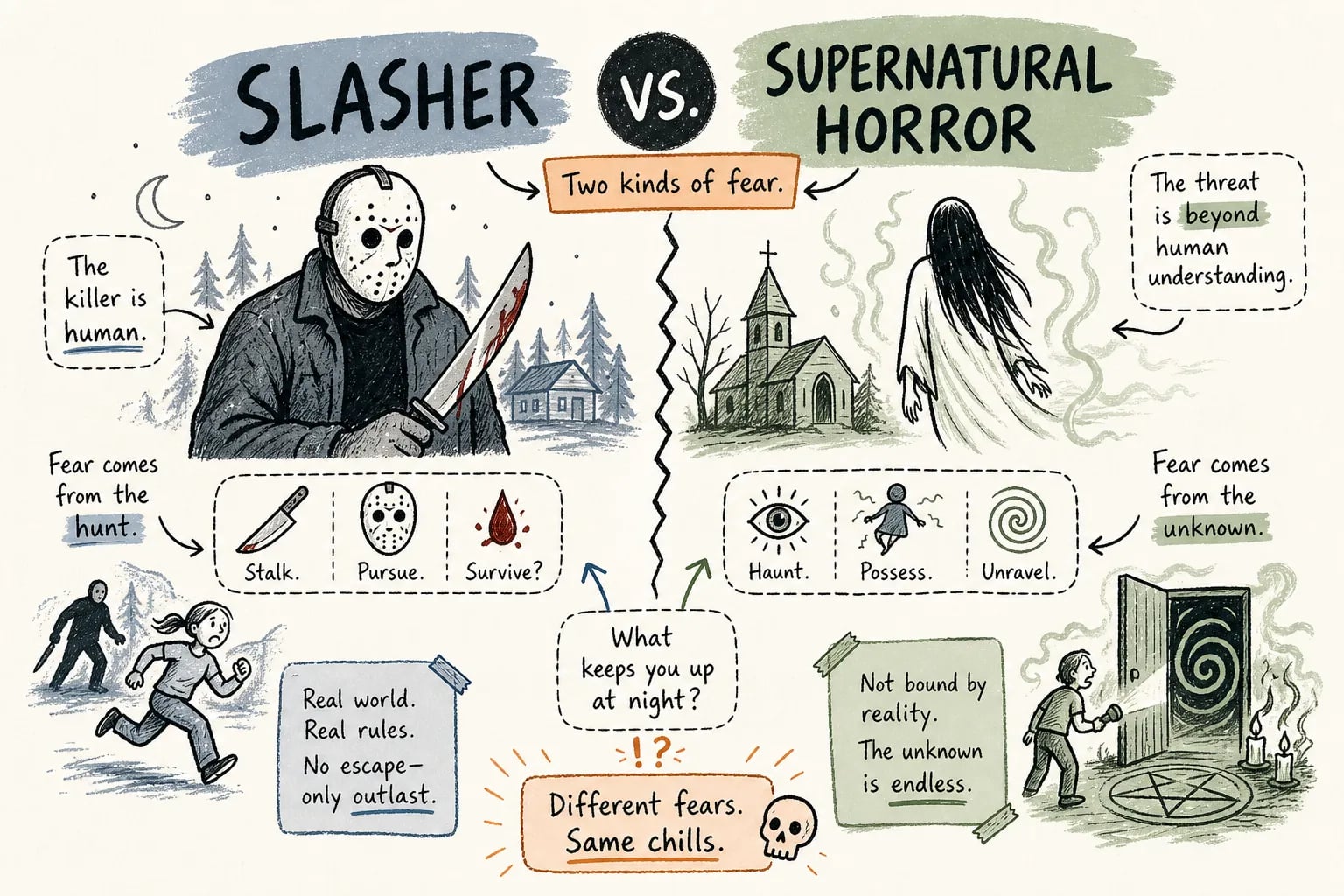
You’re recommending a horror film to a friend and they ask, “Is it like a ghost thing or more of a killer thing?” You know the answer intuitively, but when you try to explain it, the words get slippery. Both subgenres are horror. Both make you check the locks before bed. So what is the difference between slasher and supernatural horror, really, at the level of mechanics, not just mood?
The answer runs deeper than surface aesthetics. Each subgenre is built on a distinct fear architecture, a specific kind of antagonist, and a completely different set of rules about how threats operate. Understanding those mechanics changes how you watch, how you write, and how you choose what to put on next. Here at The Dark Threshold, we take these distinctions seriously, because genre literacy is the foundation of real horror appreciation.
This breakdown covers what defines each subgenre, how their scare tactics differ psychologically, which films anchor each tradition, and how to classify the tricky hybrids that borrow from both sides.
What is the difference between slasher and supernatural horror?
The short answer: slasher horror gives you a threat you can see, chase, and, sometimes, stop. Supernatural horror gives you a threat you can barely understand, let alone outrun. But the longer answer is worth unpacking, because the mechanics behind each subgenre explain why they feel so different even when they share a genre label.
The anatomy of a slasher film
A slasher film lives or dies on its killer. The antagonist is human or quasi-human, typically masked or physically distinct, armed with a signature weapon, and driven by some combination of trauma, revenge, or compulsion. That psychological grounding, even when it’s only sketched in backstory, is what separates the slasher villain from a supernatural entity. The threat feels immediate because it comes from something that was once a person operating inside the same physical world as the victims.
The narrative skeleton is recognizable after a few films: a traumatic inciting event, a group of young victims in an isolated or confined setting, a sequence of kills that systematically reduces the ensemble, and a climactic confrontation with one surviving character, traditionally the “final girl.” Visually, slashers rely on point-of-view camera work that toggles between hunter and hunted, prolonged stalking sequences, and graphic kill scenes staged as set pieces. The confined setting, whether a summer camp, a suburb, or a hospital, ensures that victims have nowhere obvious to run.
The tropes that populate slasher films aren’t accidents. The final girl, the first victim, the skeptical authority figure who refuses to believe anyone, the transgressors who die for their rule-breaking: these archetypes serve a structural purpose. They frame the killer as a human predator operating inside a recognizable social hierarchy, which makes the threat feel like it could happen somewhere you know. Spot these archetypes in the first act and you’re almost certainly watching a slasher film.
What supernatural horror actually means
Supernatural horror centers on a force that cannot be explained by ordinary human logic. The antagonist, whether a restless spirit, a demonic presence, a cursed object, or an ancient entity, operates by its own set of rules. Those rules are often unknown at the start of the film, and a significant portion of the story involves the protagonist trying to discover them before the situation becomes unsurvivable. That investigative quality is a key structural difference from slasher horror, where the killer’s behavior is physically observable even if their motive is obscure.
The visual language of supernatural horror reinforces that sense of wrongness. Low-key lighting, decaying environments, flickering lights, moving objects, and silhouettes appearing at the edge of frames all signal that the physical world is no longer reliable. The settings tend toward spaces with history: old houses, cursed locations, forests with a past. Where slasher films use isolation to trap victims physically, supernatural horror uses location to establish that something is already present, and has been for a long time.
The core tropes in this subgenre point toward an existential register of fear. Haunted locations, possession sequences, escalating paranormal events, and ambiguous or unresolved endings all reinforce a central idea: the problem isn’t just the entity, it’s that reality itself can no longer be trusted. The protagonist isn’t only trying to survive; they’re trying to understand the nature of a threat that doesn’t play by rules they were taught to rely on.
How slasher vs. supernatural horror deliver fear differently
Slasher fear is immediate and physical. It triggers the fight-or-flight response because the threat is present, relentless, and comprehensible. You know what it is. You know it’s coming. Your nervous system responds to chase scenes and sudden strikes the same way it would to a real predator, with a spike of acute arousal that demands a bodily reaction. This is why slasher films feel urgent even when their premises are implausible: the fear arrives in discrete, intense jolts.
Supernatural horror operates on a completely different timeline. The dread builds slowly, accumulating through wrongness rather than pursuit. Atmospheric and ambiguity-driven horror tends to produce sustained hypervigilance rather than a brief panic spike, the kind of unease that film scholars and genre critics have observed across decades of horror film analysis. The threat can’t be outrun because it may not occupy physical space the way a human killer does. It can be in the walls, in a bloodline, in a dream. The emotional effect isn’t panic: it’s the slow, unsettling sense that the ground beneath your understanding of the world is no longer solid.
The aftereffect tells you everything. Slasher fear fades when the credits roll because the threat was concrete and the confrontation resolved it, one way or another. Supernatural horror lingers, sometimes for days, because the brain keeps filling in gaps with worst-case possibilities. That lingering quality is a feature, not a flaw. It’s what separates a film that scares you once from one that haunts you.
Classic films that anchor each subgenre
Halloween (1978) is the defining text for slasher horror. Michael Myers is human. His setting is suburban. The film offers zero supernatural explanation for his behavior or survival. John Carpenter’s POV camera work places you behind the mask and in front of it in alternating sequences, and the final girl structure arrives fully formed. Every slasher film that followed either built on this template or reacted against it. Friday the 13th amplified the body count and gore; Scream dissected the formula in real time and still managed to terrify while doing it.
Four films establish the range of what supernatural horror can do. Rosemary’s Baby (1968) uses paranoia and gaslighting to make the viewer question whether the threat is real, until it unambiguously is. The Shining (1980) destabilizes its protagonist and its audience simultaneously through a location governed by malevolent rules. The Conjuring (2013) takes a more conventional haunting and executes the escalating-paranormal structure with precision. Hereditary (2018) stands apart: it delivers a demonic curse unfolding through family trauma in a way that makes the supernatural feel inevitable rather than intrusive, arriving not as a genre device but as a kind of terrible inheritance. Each film demonstrates a different flavor of supernatural menace, which shows how much variety lives within this single subgenre.
A Nightmare on Elm Street (1984) is the edge case that confuses most classification attempts. On the surface it looks like a slasher: masked killer, teen victims, sequential deaths, a final girl. But Freddy Krueger’s power source is entirely paranormal. He attacks through the dream world, his rules are supernatural, and surviving him requires understanding those rules rather than simply outrunning him. That’s not a slasher operating with special effects. That’s a supernatural horror film wearing slasher clothes, and recognizing the difference is exactly why understanding the mechanics matters more than reading surface elements.
When slasher meets supernatural: how hybrids actually work
Freddy Krueger is the clearest example, but he’s not alone. Candyman combines a slasher’s physicality and kill count with a supernatural origin rooted in historical trauma and urban legend. Jeepers Creepers presents an antagonist that stalks and hunts like a slasher villain but operates by paranormal rules no human predator could follow. These hybrids work because they use the familiar surface language of slasher horror, the pursuit, the body count, the isolated setting, to deliver supernatural dread. The recognizable wrapping makes the unfamiliar rules feel more unsettling, not less.
Identifying which subgenre is dominant in a hybrid film comes down to two questions. First: what kind of threat is the antagonist, human or otherworldly? Second: what kind of fear does the film primarily generate, physical urgency or existential wrongness? Apply those questions to Candyman and the answers point toward supernatural, despite the presence of slasher-style kills. Apply them to Halloween and the answers point cleanly toward slasher, despite Michael Myers’ apparent invulnerability. Most films lean toward one side even when they borrow generously from both, and those two questions will tell you which side carries the weight.
A quick checklist to classify any horror film
Once you understand the mechanics, classification becomes fast. Run any film or story through these four diagnostic questions:
- Is the antagonist human, once-human, or fully otherworldly?
- Does the fear come from physical pursuit or psychological and atmospheric dread?
- Are there slasher archetypes (final girl, body count structure, masked killer) or supernatural tropes (haunting, possession, cursed rules, ambiguous endings)?
- Does the ending feel resolved, with the physical threat defeated, or unsettling, with the wrongness still lingering?
These questions work equally well whether you’re trying to categorize a film you just watched or build a story in a specific subgenre. Writers find them especially useful for identifying which fear register their work is actually operating in, because many drafts accidentally mix the two and dilute the effect of both.
At The Dark Threshold, the deep-dives, rankings, and analysis across both slasher and supernatural horror are organized around exactly this kind of genre literacy. Whether you find yourself drawn to the immediate physical urgency of slasher horror or the slow, creeping dread of a ghost story, there’s a reading list here built for where you are, with the subgenre context to tell you exactly what you’re stepping into.
The two questions that will change how you watch horror
When you ask what is the difference between slasher and supernatural horror, the real answer isn’t a genre label. It’s a fundamental difference in how fear is constructed, delivered, and experienced. Slasher fear is physical, spike-driven, and resolved at the credits. Supernatural fear is existential, cumulative, and built to outlast the runtime. Both are valid. Both have produced some of the most important films in horror history. Understanding which one you’re watching, and why it’s affecting you the way it is, makes you a sharper viewer and a more intentional recommender.
Hold onto those two questions: what kind of threat is the antagonist, and what kind of fear does the film generate? They’ll classify almost anything you encounter, including the hybrids that borrow from both traditions. The best horror often lives exactly at that boundary, using one subgenre’s grammar to say something the other couldn’t quite reach.
If a film is keeping you up at night and you’re not sure why, the answer usually lives in that distinction between slasher and supernatural horror, between a threat that chases you through the dark and one that makes you question whether the dark was ever safe to begin with. That’s the threshold. And it’s always worth crossing.
Leave a Reply