
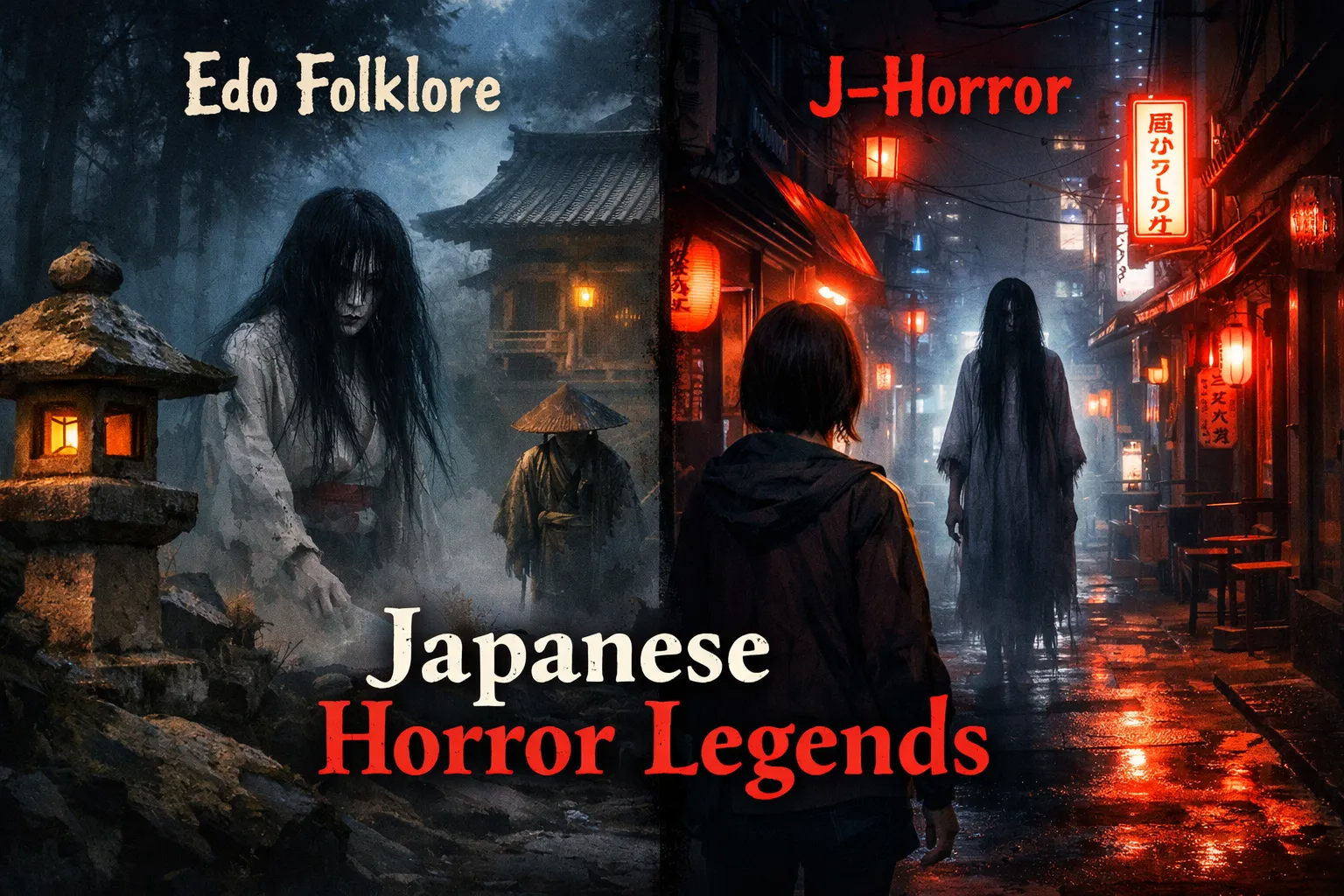
Japan has one of the oldest, most architecturally complex traditions of fear in the world. Before Sadako crawled out of a television set, there were centuries of candlelit kaidan sessions, Edo-period woodblock prints of spider women, and schoolchildren whispering warnings in bathroom stalls. Japanese horror legends are not random collections of scary stories: every legend carries a full cultural address, a social wound, a Buddhist concept, a Shinto belief twisted sideways. Here at The Dark Threshold, we have covered horror traditions from dozens of cultures, and Japan’s stands apart not because its spirits are the scariest, but because they are the most precisely designed. This guide traces the full arc of Japanese horror legends from classical yokai mythology to modern urban myths, from ink-brush illustrations to international cinema.
The cultural framework of Japanese horror legends: yokai, yurei, and onryō
Without understanding three key terms, you will misread every legend that follows. Yokai (妖怪) is the broadest category: supernatural entities ranging from shapeshifters and tricksters to possessed objects and nature spirits. The word combines kanji meaning “bewitching calamity” and “mystery,” and it is rooted in Shinto animism, the belief that every object, landscape, and emotion can house a spirit. Edo-period artists like Toriyama Sekien catalogued hundreds of yokai in illustrated volumes; many legends we treat as ancient were actually codified during this period of cultural prosperity. Not all yokai are malevolent. The horror comes from imbalance, disrespect, or neglect of the spirit world.
Yurei (幽霊) are something more specific: the ghost of a particular dead person, typically depicted in a white burial kimono with loose black hair obscuring the face. Unlike yokai, which are beings in their own right, yurei are driven by unresolved emotion or improper funeral rites. Most onryō (怨霊), the vengeful spirits at the center of Japanese horror’s most famous stories, are yurei rather than yokai. Buddhist doctrine adds another layer: the concept of lingering attachment (執着) explains why a spirit remains tethered to the world rather than passing on. Understanding this distinction is the master key to Japanese ghost lore.
Kaidan (怪談) is the container that held all of this together. Translated roughly as “strange tales,” it was a literary and performance genre that peaked during Edo prosperity. The hyakumonogatari kaidankai ritual involved lighting 100 candles and extinguishing one after each ghost story, daring the supernatural to enter as the room grew darker. Kaidan explains why Japanese horror legends have such precise narrative structures: they were not improvised campfire tales but crafted pieces with moral architecture and built-in dread. Every legend that follows emerged from this tradition.
Legends carved from classical Japan: the Edo-period originals
These are the horror stories with deep literary and theatrical roots, recorded in kabuki plays, illustrated in woodblock prints, and retold across centuries. They are not urban myths. They are kaidan, and they form the bedrock of Japanese horror legends as we understand them today.
Okiku is Japan’s most haunted counting game. Her story originates in the kabuki play Bansha Sarayashiki: a servant girl falsely accused of breaking one of ten heirloom plates is murdered and thrown into a well. Her ghost haunts the site by counting: “one… two… three… nine…” then breaking into a shriek at the number she can never reach. Okiku’s Well (お菊井戸) at Himeji Castle is a documented historical site that tourists still visit today, the legend woven into official castle history. Her story is a textbook onryō archetype: a woman destroyed by those with power over her, returning through obsessive repetition to mark her unfinished grievance.
Yuki-onna, the snow woman, belongs to the alpine regions of Japan and was documented for Western readers in Lafcadio Hearn’s Kwaidan in 1904. She appears during blizzards as a pale, ethereal figure who freezes travelers with her breath or drains their life force while they sleep. What makes her remarkable is her moral ambivalence: she spares those she loves, provided they keep her secret. The terror is not in the monster but in the boundary. She reflects the Shinto understanding of nature as simultaneously beautiful and lethal, and the horror of forgetting which side of that boundary you are standing on.
Jorogumo is a yokai of the Edo period who masquerades as a beautiful woman to lure and consume men, eventually revealing herself as a giant spider. Her origins connect directly to weaving and silk production; the horror is coded into economic metaphor. The visual iconography of a woman unraveling into spider legs became foundational to Japanese horror aesthetics in manga and film alike. Her “beautiful monster” archetype recurs across Japan’s most terrifying legends, the seductive face concealing something catastrophically inhuman beneath.
The urban horror wave: when Japanese horror legends went modern
The Showa and Heisei eras produced a different kind of Japanese ghost story. These legends are urban myths, often traceable to a specific decade or event, spreading through word of mouth in schools before internet culture amplified them globally.
Kuchisake-onna, the slit-mouthed woman, has layered origins: a samurai’s jealous punishment in some versions, a surgical disaster in others, an Edo-period kitsune prank in still others. The multiplicity is part of its power. What is documented clearly is the 1979 moral panic: Japanese schools reported children refusing to walk home alone, and police genuinely responded to community concern. The legend’s survival tactics reveal something unique about Japanese urban horror: escape is ritualized. Offering hard candy, shouting “pomade” three times, calling her “average”, each method is a specific countermeasure encoded into the myth itself. These legends do not just frighten; they train.
Teke-Teke is a schoolgirl bisected by a train, now a bloodied upper torso dragging herself on razor-sharp elbows with a scraping sound. The train is Japan’s national icon of modernity and efficiency. Her origin in that machine is not accidental. She represents postwar Japanese horror at its most culturally specific: industrial progress creating new categories of violent, fragmented death. She asks if you know her name before bisecting her victims, mirroring her own severed state in the question.
Aka Manto haunts the last stall of school bathrooms, offering red or blue toilet paper. Red: you are skinned alive. Blue: you suffocate. Any other answer drags you to the underworld. Like most Japanese urban legends, there is no safe choice, only different kinds of doom. The binary structure is a recurring motif in these stories: they do not offer hope of escape through cleverness. They offer only the shape of the consequence.
School spirits and the geography of childhood fear
Japan’s school ghost tradition is distinct enough to stand on its own. Folklorist Tsunemitsu Tōru formalized the genre in a 1990 book, though the oral tradition runs much deeper. Schools became the primary habitat of modern Japanese folklore ghosts for structural reasons: the Education Order of 1872 standardized school construction across Japan, creating long corridors, locked rooms, and institutional uniformity that made every building feel like every other building. At some schools, teachers have reportedly passed ghost legends to new staff as a form of institutional memory.
Hanako-san haunts the third stall of school bathrooms. Knock three times, call her name, and a girl in a red skirt answers “Hai.” Origin theories tie her to WWII air raids and wartime childhood tragedy, embedding historical grief into an everyday space. The third stall carries weight because numbers matter in Japanese superstition: three sits at a liminal point, neither beginning nor end. Regional variants change the outcome from a scare to death to abduction, but the ritual of summoning stays constant.
Hachishakusama is a towering woman in a white hat and dress who lures children with a voice mimicking their mother: “Po… po… po…” She originated as a Japanese internet legend on 2channel (2ch) in the early 2000s before acquiring the gravity of older folklore. What distinguishes Hachishakusama from Western horror logic is the escape: it requires a communal ritual involving shrines, protective charms, and being physically escorted out of the region. Japanese horror rarely resolves through individual heroics. The community holds the solution, not the protagonist.
Real locations where legend and landscape overlap
Some of these Japanese horror legends have physical addresses. Okiku’s Well at Himeji Castle is the clearest example: a documented historical site at a castle dating to the 14th century, where the legend is woven into official tourism materials. Standing at the well’s edge makes Okiku territorial rather than theatrical. The land holds the grudge, and that relationship between place and legend defines Japanese horror at its most durable.
Hashima Island, known as Gunkanjima, is a coal mining island evacuated in 1974 whose seven-story school building is one of the most photographed ruins in Japan. Structural collapse, tidal flooding, and complete silence make it an authentic horror location without needing a single specific legend attached. It has absorbed multiple ghost stories simply by proximity: a space that looks exactly like a horror set acquires myth by gravity. The island gained broader international recognition through its use in the 2012 James Bond film Skyfall, but its reputation as a haunted space predates that by decades.
From kaidan to cinema: how these legends crossed oceans
The leap from oral tradition to global pop culture was not accidental. Japan’s supernatural stories translated into cinema because they already had what good horror films require: a clear visual grammar, a moral architecture, and a villain who cannot be reasoned with.
Koji Suzuki’s 1991 novel Ring drew directly on onryō mythology: the pale-faced, black-haired spirit wronged by the living, returning through an uncanny medium. Hideo Nakata’s 1998 film adaptation brought the visual vocabulary of yurei to international screens, with Sadako’s wet hair and white burial dress tracing directly back to Edo-period ghost imagery from kabuki theater. The 2002 American remake made Sadako a household name globally. The medium changed from a cursed well to a cursed videotape. The grudge structure did not change at all.
Takashi Shimizu’s Ju-On (2002) stripped the onryō legend to its most essential element: the grudge that spreads like infection regardless of the victim’s innocence. Unlike Western horror where fleeing can save you, Ju-On codified the logic that the curse follows you home. Kayako’s cracked neck and death rattle trace back to Edo-period theatrical ghost depictions from Yotsuya Kaidan, the 1825 kabuki play about a betrayed wife’s return. Western audiences who encountered the 2004 remake had no cultural frame for that sound, and they were more terrified for it.
Why Japanese horror legends still matter
Japanese horror legends endure not because Japan has more ghosts, but because Japan has kept better records of its fear. Every legend examined here carries a cultural fingerprint: Buddhist impermanence in Yuki-onna’s mercy, Shinto imbalance in Jorogumo’s seduction, modern industrial anxiety in Teke-Teke’s train tracks, wartime grief in Hanako’s bathroom stall. The vocabulary of yokai, yurei, onryō, and kaidan is not jargon. It is a map.
These Japanese ghost stories remain some of the most structurally sophisticated in the world, and they form one pillar of a much wider architecture of global folklore fear. Latin American supernatural creatures, Eastern European spirit traditions, West African lore, each carries the same cultural density, the same compressed history of human dread. The Dark Threshold covers all of it with the same depth applied here: the folkloric roots, the cultural context, the cinematic descendants. We have barely scratched the surface of what the world’s dark folklore has to offer. Come find the rest of it.
Leave a Reply