
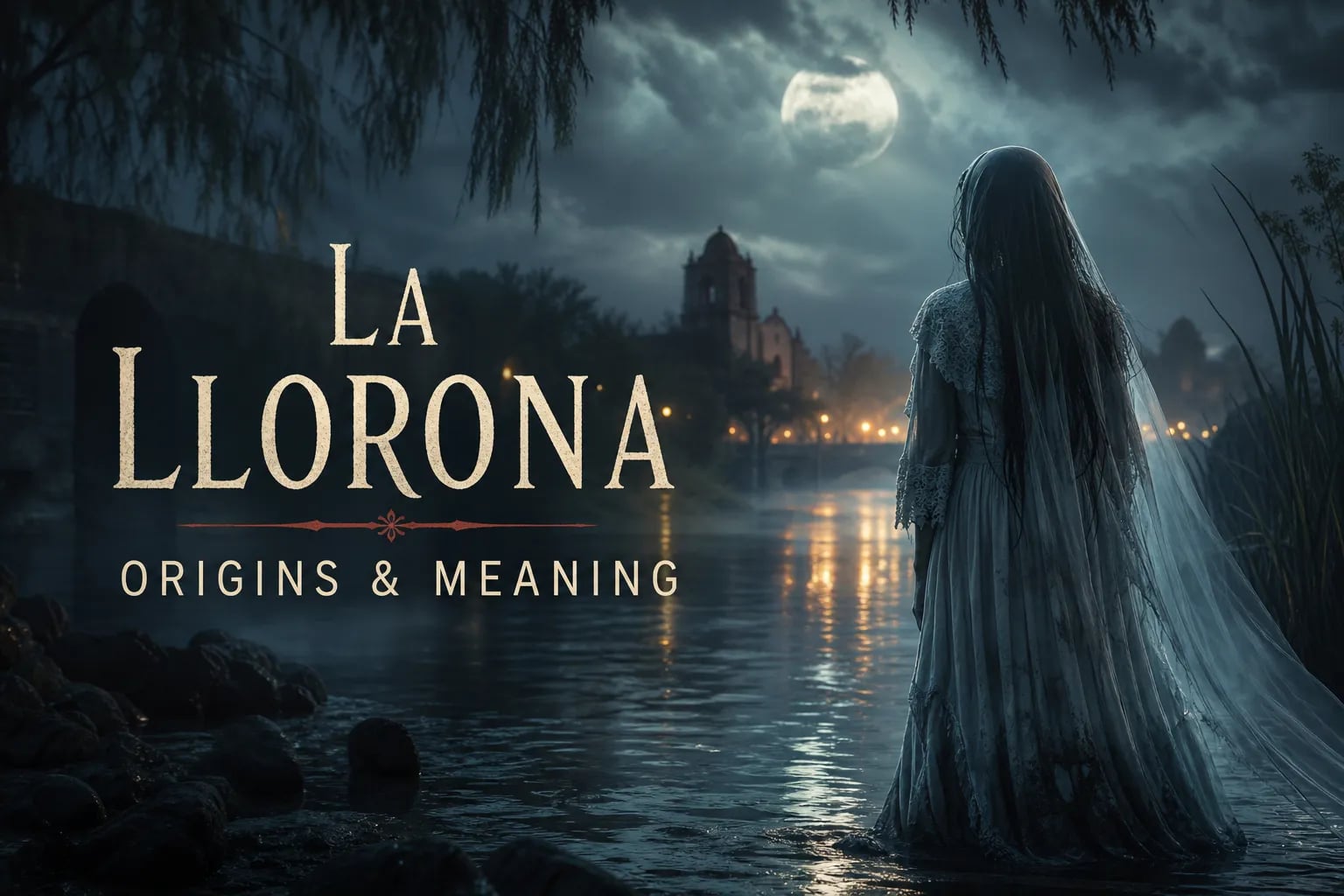
La Llorona story explained: somewhere near water, in the dark, a woman weeps. Her cry isn’t gentle. It’s the kind of sound that peels back the night, a long, broken wail that carries across centuries and continents without losing any of its grief. That sound is La Llorona. And if you’ve only ever heard her name in passing, or only know her from a Hollywood trailer, you’ve barely scratched the surface of one of the most enduring and psychologically complex ghost stories in Latin American folklore.
La Llorona is not a simple children’s warning, though she has been used that way. She is a cultural wound, shaped by conquest, patriarchal violence, Indigenous loss, and the particular grief of communities whose histories were rewritten by outside forces. Her story has survived for centuries because it carries something real inside it, something that every generation has found a reason to pass on.
At The Dark Threshold, this is exactly the kind of horror legend we exist to explore. Not the sanitized version, not the studio version, but the full genealogy of fear. This article covers La Llorona’s pre-colonial origins, her colonial transformation, her regional variations across Mexico, Central America, and the US borderlands, and what the legend is actually saying beneath the surface. By the end, you’ll understand not just the story, but why it refuses to die.
La Llorona story explained: the Aztec roots hiding behind the legend
Cihuacóatl and the goddess of grief
Long before La Llorona became a neighborhood ghost wandering city canals, a figure remarkably similar to her was already embedded in Nahua belief systems. Cihuacóatl, the Aztec serpent goddess, was associated with mourning, childbirth, and warfare. Her iconography described a weeping woman dressed in white, and she was said to cry out in the night for a lost child, a detail that will feel familiar to anyone who knows the Weeping Woman legend in its later forms.
The most significant early documentation comes from Bernardino de Sahagún’s 16th-century ethnographic work, compiled in the Florentine Codex. Sahagún recorded indigenous accounts of a woman heard weeping through the streets of Tenochtitlan at night, crying out, “My children, where shall I take you?” This apparition was described as the sixth omen preceding the Spanish conquest, which means the La Llorona origin story isn’t a colonial invention. She was already there, already weeping, before Cortés arrived.
From omen to legend: the pre-colonial thread
The distinction between a goddess-figure and a ghost-figure matters here, and in oral tradition, that line blurred quickly. Cihuacóatl was a divine being; the apparition recorded in the Florentine Codex reads more like a haunting. What connects them is the imagery of a powerful, grief-stricken mother figure linked to darkness, loss, and the supernatural. Coatlicue, another major figure in Nahua belief, adds to this pattern as an earth-mother tied simultaneously to fertility and death, reinforcing the idea that indigenous Mexican cosmology already had a fully developed vocabulary for mourning womanhood. She grew from a belief system that had already spent generations linking femininity, grief, and the spirit world into a single, coherent archetype. That foundation is why she survived colonization, absorbed new influences, and kept going.
How Spanish colonization changed her story
The La Malinche connection (and why it’s complicated)
When the Spanish arrived and reshaped every institution in Mexico, including its storytelling, the Weeping Woman absorbed new layers. The most significant fusion that developed over the colonial period connected La Llorona to La Malinche, the indigenous Nahua woman who served as Hernán Cortés’s interpreter and companion during the conquest. In Mexican cultural memory, La Malinche is a profoundly contested figure, simultaneously framed as a traitor and a victim, the woman who helped dismantle her own civilization and the woman who had no real choice in the matter.
Later oral tradition merged these two figures, casting La Malinche as the weeping mother whose children, symbolic of the mestizo people born from conquest, were lost forever. One critical detail needs to be stated plainly: there is no historical evidence that the real La Malinche harmed her children. That element belongs to the folklore, not her biography. Her documented life was sparse enough that the mythology had room to grow into it, filling gaps with the grief that conquest had actually caused. The fusion worked because communities needed a face for an enormous, collective loss.
The birth of oral tradition across New Spain
As the legend traveled through colonial Mexico, it absorbed European ghost-story conventions while keeping its indigenous emotional core intact. The goddess-omen became a neighborhood haunting. La Llorona began appearing in city streets and along waterways rather than in mythological accounts, which meant she moved from sacred text to lived experience. Manuel Carpio’s 1849 poem is the earliest surviving published literary version of the legend, and by that point the story was already formalized enough to be written down as a known quantity rather than an explanation.
That shift from divine omen to local ghost changed everything. A neighborhood ghost is more intimate and more threatening than a goddess. She isn’t warning you about civilizational collapse. She is on your street, near your river, looking for children.
Regional variants: one legend, many faces
Mexico’s urban versions and the canals
The Mexico City variants of La Llorona are deeply tied to the geography of Tenochtitlan, the Aztec city built on a lake that the Spanish drained and built over. In these versions, she haunts the old waterways, the canals of Xochimilco, the colonial streets, still crying for children lost to water and history. The most common Mexican version centers on a woman betrayed by a man of higher social standing, often a Spaniard or a criollo, who drowns her children after being abandoned and becomes a condemned wandering specter. The class dynamics here aren’t incidental. They reflect real colonial and post-colonial social tensions, the vulnerability of indigenous and mestiza women within systems that afforded them almost no protection.
La Llorona story explained across regional variants: Central America and the borderlands
In Central America, La Llorona often functions primarily as a moral enforcer. The ghost story becomes a tool for keeping children away from rivers, discouraging disobedience, and warning adults about infidelity or social transgression. The origin story is sometimes stripped back or localized to a different kind of tragedy: an affair, a hidden pregnancy, a child drowned to hide scandal rather than to punish a faithless man.
In the US Southwest and borderland Hispanic traditions, she shifts again. The Rio Grande and similar waterways become her territory, and she is sometimes framed less as a grieving mother and more as a warning presence, a figure encountered near water or at night without the full backstory attached. Some versions cast her as an avenging spirit targeting unfaithful men rather than a woman consumed by grief. In Colombia and surrounding regions, similar figures appear under entirely different names, including La Tarumama, demonstrating how fluid these traditions are across geography. Every community reshapes her to fit its own specific anxieties. That adaptability is why the La Llorona legend has survived at all.
La Llorona meaning: what the legend really says about cultural fears
Motherhood, betrayal, and what “bad mother” really means
The traditional reading of La Llorona casts her as a cautionary figure for women who fail their maternal duty. That reading served a social function, using fear to enforce norms around proper womanhood and motherhood. But that framing collapses under scrutiny the moment you look at the actual story. In most variants, she kills or loses her children because she was betrayed, abandoned, or socially destroyed first. She acts in the aftermath of a man’s violence or rejection, and then she alone carries the eternal punishment.
Scholars including Gloria Anzaldúa have reinterpreted her as a figure shaped by patriarchal violence rather than simply a villain who failed her children. In this reading, her cry isn’t a confession. It’s a protest. She is not asking forgiveness; she is refusing to be forgotten. That reinterpretation has found real traction in Chicana literature, visual art, and cultural criticism, where La Llorona becomes a symbol of women’s suffering rather than women’s failure.
Colonial grief and the legend as cultural memory
The postcolonial reading of the legend adds another layer: the children she mourns are not only literal children but land, language, identity, and people. In this interpretation, La Llorona is an allegory for indigenous loss under Spanish conquest, the grief of communities that watched their entire worlds dissolve within a generation. This is why she appears so persistently in Chicano and Chicana cultural expression, from literature to murals to music. She carries the weight of a historical trauma that official history has often minimized or erased.
The legend works on two levels simultaneously: as a social warning that regulates behavior, and as a vehicle for collective mourning. That dual function is exactly what gives her staying power across centuries and borders. She can be both a ghost story and a political statement, depending on who is telling her and why.
From folk ghost to Hollywood villain: what adaptations changed
Classic Mexican cinema and the roots of screen horror
Mexican cinema came to La Llorona early. The 1933 film, followed by adaptations in 1960 and 1963, were among the first attempts to translate the legend for a mass audience. These films stayed relatively close to the folk ghost format, introducing the visual language that later adaptations would inherit: the white gown, the canal, the wail in the dark. They treated her as a tragic figure rooted in a specific cultural and historical context rather than as a generic monster.
The two 2019 films and why they could not be more different
2019 produced two films bearing La Llorona’s name, and they represent almost opposite approaches to the legend. The Curse of La Llorona, produced within the Conjuring universe, strips the cultural context away entirely. She becomes a supernatural villain in a suburban American setting, a generic threat without the colonial history, the class dynamics, or the feminist subtext that give the original legend its meaning. The film offers surface-level horror, but without that cultural grounding, the folklore loses its teeth.
Jayro Bustamante’s Guatemalan film La Llorona, released the same year, took a fundamentally different approach. Bustamante connected the legend to the real history of Guatemala’s genocide and civil war, centering the story on a retired general modeled on Efraín Ríos Montt, whose crimes against Mayan communities were never fully prosecuted. In Bustamante’s version, La Llorona isn’t crying for her own lost children. She is crying for an entire people. The haunting is not personal but historical, the past forcing its way back into the present through a ghost that refuses to let the powerful forget what they did.
The La Llorona song tradition deserves mention here as well. From traditional folk ballads bearing her name to Rebekah Del Rio’s haunting performance in Mulholland Drive, where she appears as La Llorona de Los Angeles, music has long understood what cinema sometimes misses: that the figure migrates and transforms but never loses her grief. The lesson across both 2019 films is clear. When folklore travels without its cultural context, the meaning hollows out. When it travels with that context intact, it becomes something more powerful than horror.
She is still out there, crying
La Llorona is not one story. She is a living legend that every culture and every generation has reshaped to carry its own specific grief. She began as a pre-colonial omen in Tenochtitlan, recorded by Sahagún in the Florentine Codex, tied to Aztec goddesses of mourning and birth. She became a colonial cautionary tale fused with the trauma of conquest and the contested memory of La Malinche. And she evolved into a symbol of resistance and collective grief, reclaimed by Chicana scholars, Guatemalan filmmakers, and communities who recognized in her cry something that was never really about one woman at all.
What makes her extraordinary is that she contains all three of those layers at once. You can read her as a warning, a protest, or a monument to everything that was taken. None of those readings cancel the others out. She is a ghost who carries history, which is the most frightening kind.
Now that the La Llorona story has been explained in full, from her pre-colonial Aztec roots to her reinvention in contemporary film, it becomes clear why she refuses to die. The Dark Threshold covers legends like this across cultures, from Japanese kaidan and its tradition of vengeful female spirits to Andean mythology to North American cryptid lore. There is a whole world of cultural darkness waiting to be explored. La Llorona is still weeping somewhere near water, and now you know exactly what she’s mourning.
Leave a Reply