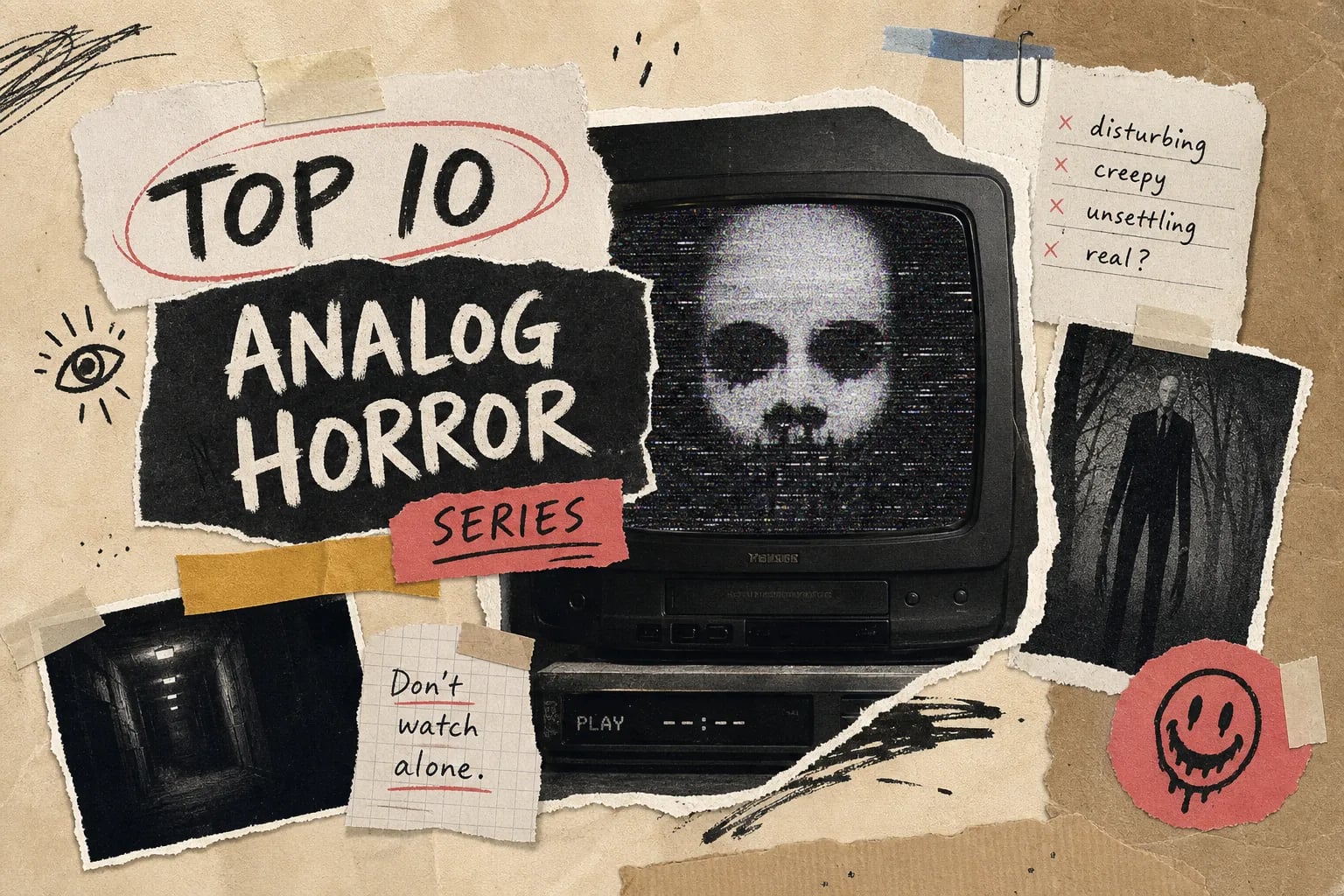
If you’re searching for what are the scariest analog horror series to watch, you’ve reached the right frequency. Most horror wants you to flinch. Analog horror wants you to doubt. There are no jump scares timed to a violin sting, no monster that conveniently steps into frame. Instead, something is simply wrong with the broadcast you’re watching, the nature video that shouldn’t exist, the children’s show that ended thirty years ago. The dread doesn’t arrive in a rush; it accumulates, frame by degraded frame, until you’re not sure what you actually saw.
Here at The Dark Threshold, we’ve been tracking analog horror since its earliest experiments on YouTube, cataloging what each series does to the viewer and building a working archive of the genre over time. This is not a random listicle pulled together overnight. This is a curated report built for readers who want to know exactly what they’re getting into before they hit play.
Every entry in this analog horror list is broken down by what type of fear it produces, where you can watch it legally, which episode to start with, and what content warnings apply. The scariest analog horror series to watch isn’t always the most famous one; it’s the one that matches your specific fear threshold. Some of these will rot your sleep slowly. Others hit like an existential freight train on the first viewing.
What Actually Makes Analog Horror So Unsettling
The VHS Aesthetic as a Trust Weapon
The lo-fi, degraded visual format of analog horror mimics formats the human brain already associates with authenticity: public access TV, government emergency broadcasts, old home video tapes. These are not the visual languages of fiction. They’re the visual languages of reality. When a series presents itself through that lens, your brain’s usual “this is a movie” filter doesn’t fully engage, even when you consciously know it’s fake. The format bypasses the fictional contract, a mechanism that media scholars and film critics have described as an authenticity cue, a signal that collapses the distance between document and viewer.
Psychological Manipulation Through Restraint
Conventional horror signals its scares with music, lighting, and pacing. Analog horror removes all of those cues. No swelling strings, no slow push toward the monster, no obvious release valve. Instead, wrongness accumulates quietly through distorted audio, dead air, uncanny imagery, and bureaucratic calm that doesn’t belong anywhere near what’s being described. That restraint is what makes these series so effective on rewatch. You keep catching details you missed, which means the dread never fully resolves.
What Are the Scariest Analog Horror Series to Watch, The Undisputed Top Tier
Local 58: The Series That Made Public Access TV Feel Like a Threat
Creator: Kris Straub. Debut: 2015. Local 58 is a fictional local television station that transmits increasingly disturbing emergency broadcasts hinting at a reality-breaking cosmic catastrophe. What makes it terrifying isn’t what it shows; it’s the bureaucratic calm with which it instructs you. The government voice tells you to do something genuinely horrifying, and it does so in the tone of a weather advisory. No monsters. No screaming. Just the cold, official language of a system that has broken down in a way it can’t acknowledge.
Start with “Weather Service,” the first release in the series. Watch in release order from there: Contingency, You Are on the Fastest Available Route, Show for Children, Real Sleep, Skywatching, and Night Walk. The full series is free on YouTube. Content warnings: disturbing imagery, self-harm adjacent themes in certain episodes, photosensitivity, and scenes involving implied cosmic violence. (These warnings reflect editorial assessment based on content; consult the official channel for platform-level advisories.)
The Mandela Catalogue: The Alternate That Follows You Home
A fictional public safety broadcast system warns citizens about “alternates”: entities that perfectly mimic the faces and voices of loved ones to gain proximity to victims. The concept is terrifying in its simplicity. Every familiar face becomes a potential threat. The horror is relational; it exploits the exact intimacy that makes human connection feel safe and turns it into a vector for something predatory. Start with Vol. 1, widely considered the best entry point for new viewers, and watch in release order.
Free on YouTube. Content warnings: body horror, suicide themes, religious imagery, distorted faces, gun violence, psychological torture, stalking, loud noises, and flashing lights.
Cosmic Dread and Biological Unease: Horror at the Largest and Smallest Scales
Gemini Home Entertainment: The Cosmos Is Not Safe
Creator: Remy Abode. Debut: 2019. A collection of home videos and nature recordings slowly reveals that something vast and extraterrestrial has been observing and altering life on Earth. The scale of the threat is what separates this series from everything else on this analog horror list. This isn’t a killer or a ghost with a grudge. It’s something that relates to humans the way humans relate to insects: without malice, without curiosity, without the faintest trace of concern.
Start with episode one and follow the playlist in order on YouTube. Content warnings: body horror, existential dread, animal harm in select episodes, and disturbing sound design throughout.
Vita Carnis: Flesh as the Horror
Creator: Darian Quilloy. Debut: 2022. Vita Carnis documents the discovery and scientific study of a new biological organism that behaves with disturbing, purposeful intent. The clinical framing is the hook: this series presents biological horror as documentary fact, complete with taxonomy, field notes, and the dry language of academic research. The creature doesn’t need to be scary on its own, the fact that it’s being calmly cataloged is what makes it unbearable.
Start from the first entry and follow in release order on YouTube. Content warnings: graphic body horror, biological and visceral imagery, and unsettling audio design throughout.
Character Horror and the Slow Psychological Burn
The Walten Files: When Nostalgia Becomes a Crime Scene
Corporate training videos and internal recordings from a 1970s animatronic family restaurant chain reveal the truth behind a series of disappearances. The Walten Files has accumulated over 45 million total views on YouTube, figures that reflect something specific about how this series operates: it makes you care about its characters before it destroys them. It weaponizes the uncanny aesthetic of childhood mascots to deliver genuinely tragic outcomes, and you grieve for these people in a way you don’t expect from a YouTube horror series.
Start with The Walten Files 1 and watch in release order on the official YouTube channel. Content warnings: implied child harm, suicide, body horror, animatronic imagery, and sustained trauma themes.
Petscop: The Video Game That Plays Back
A YouTube channel documents the playthrough of an unreleased 1990s PS1 game that grows increasingly connected to real-world child disappearances. Petscop is patient in a way most horror content can’t afford to be. The dread builds across dozens of episodes, and the interface itself becomes the source of unease. It’s a found-footage analog horror series wearing the costume of a Let’s Play, and the disguise holds until you’re already too deep to leave.
Start at Episode 1 and follow the release order on YouTube. Content warnings: child harm themes, grief, psychological manipulation, and sustained ambiguity about what is real.
Liminal Spaces and the Gems Most People Haven’t Found Yet
The Backrooms: A Space That Was Never Meant to Be Entered
Building on Kane Pixels’ defining viral video from 2022, The Backrooms series documents found-footage exploration of an endless fluorescent-lit labyrinth existing outside normal reality. The liminal space aesthetic, wet carpet, buzzing overhead lights, empty office corridors stretching forever, turns mundane details into something deeply wrong at scale. Content warnings: claustrophobia, entity encounters, and sustained psychological distress.
Hidden Picks Worth Your Time
Three analog horror YouTube series that fewer people are talking about deserve a spot on your watchlist.
- Marble Hornets debuted in 2009 and predates the term “analog horror” entirely. It remains the foundational text for everything that came after, a Slender Man adjacent ARG on YouTube that shaped every technique the genre now relies on.
- Welcome to Old Oakburn is a more recent, underrated series praised in dedicated communities for its slow-build environmental dread and folklore-adjacent lore.
- The Monument Mythos takes an alternate-history American mythology angle that makes it one of the more distinctive voices in the space, using public monuments and national imagery to build its cosmology of wrongness.
All three are available on YouTube. The Dark Threshold maintains an ongoing guide to emerging and overlooked analog horror series, bookmark it for when this list needs an update because new entries appear regularly.
How to Choose the Scariest Analog Horror Series to Watch for Your Fear Type
What Kind of Scared Are You Looking For?
The right analog horror recommendations depend entirely on what type of dread you can sustain. Here’s a quick breakdown by fear type:
- Psychological horror rooted in paranoia and slow revelation: Local 58 and Petscop are your entry points.
- Horror that destroys you through character attachment: Start with The Walten Files or The Mandela Catalogue.
- Cosmic and existential dread, the sensation that the universe is indifferent and enormous and wrong, lives in Gemini Home Entertainment.
- Clinical, documentary-style body horror: Go directly to Vita Carnis.
- Liminal and environmental fear, the kind that makes ordinary spaces feel hostile, belongs to The Backrooms.
Content Warnings as a Tool, Not a Spoiler
Knowing that a series contains child harm themes or graphic body horror before you watch is a practical decision, not a weakness. These content warnings are listed above not to diminish the experience but to let you choose it with full awareness. The Dark Threshold maintains running content guides for analog horror specifically because this genre has a habit of escalating without warning, and readers deserve the chance to make an informed call before they’re three episodes in.
The Signal at the End of the Tape
Analog horror works because it takes formats already wired into your sense of reality, TV broadcasts, home video, nature documentaries, children’s programming, and introduces something inside them that was never supposed to be there. The familiarity of the format is exactly what makes the wrongness land so hard. You trusted the broadcast before you understood what it was broadcasting.
The genre is still evolving quickly. New series appear on YouTube regularly, and the best analog horror series to watch shifts as creators push the techniques further. What counts as the most unsettling entry today may have a serious challenger by the end of the year.
The Dark Threshold covers new analog horror drops, creator spotlights, and deeper lore dives into the series already on this list. When you’re ready for the next rabbit hole, you know where to return. Now you know what are the scariest analog horror series to watch, pick one that fits your fear threshold, and go in with the lights on. The threshold is always open.
Leave a Reply