On June 22, 2007, an anonymous user posted a short piece of fiction to 4chan’s paranormal board. It described a concrete statue that moved when no one was looking at it, held by a secret organization trained to contain the impossible. That post, now known as SCP-173, didn’t just go viral. It seeded one of the most ambitious collaborative horror universes the internet has ever produced. Nearly two decades later, the SCP Wiki hosts over 10,000 entries written by thousands of contributors across the globe.
If you’ve heard people reference “SCP” and had no idea where to start, you’re not alone. The sheer scale of the wiki is the first thing that stops newcomers cold. Consider this your field briefing, the SCP Foundation explained in plain terms: a clear, no-jargon orientation to what the SCP Foundation is, how its documents work, and exactly where to start reading. The Dark Threshold covers creepypasta, internet horror, and analog horror in depth, and the SCP universe is one of the most rewarding rabbit holes in the genre. Here’s how to open the first file.
What the SCP Foundation actually is
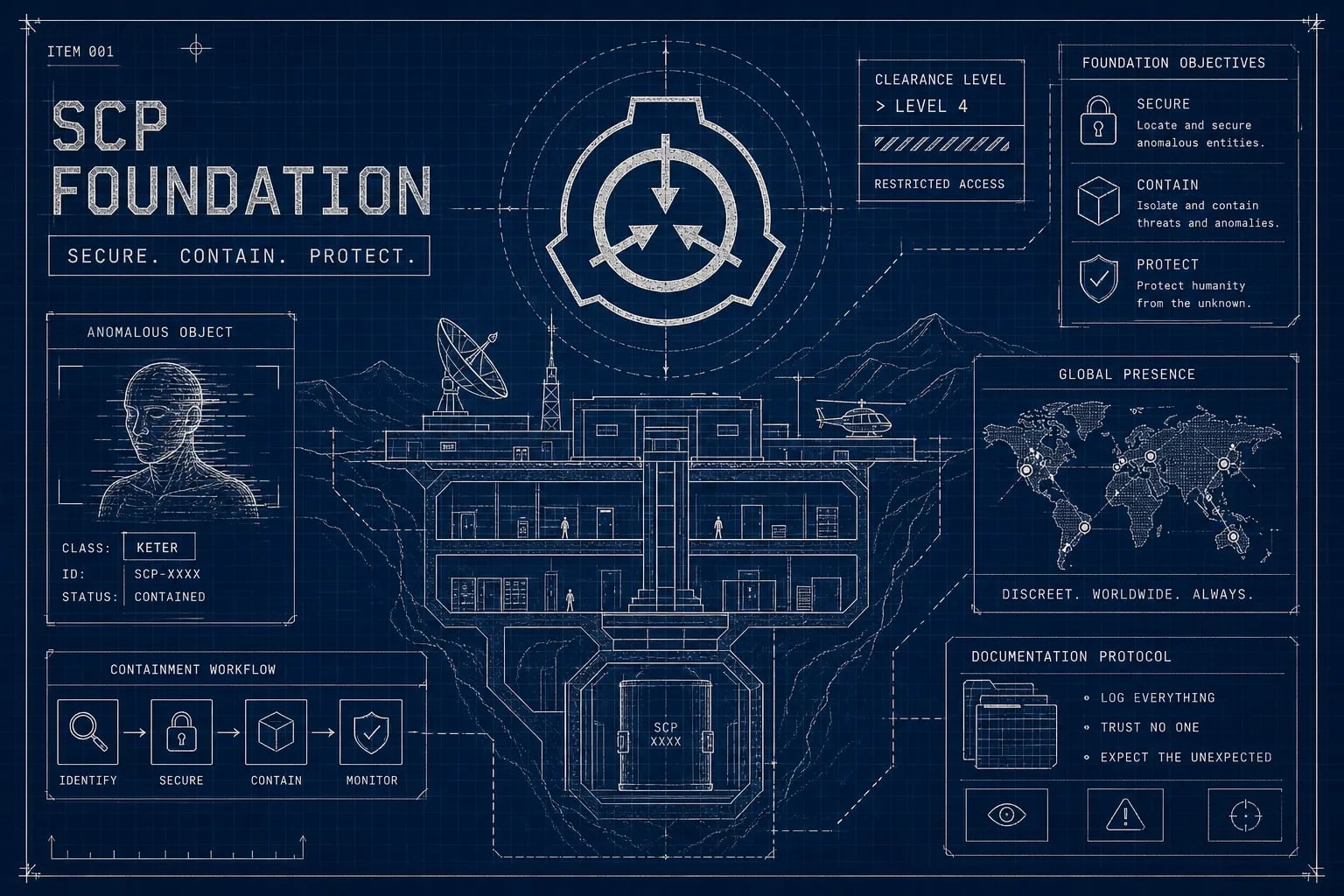
The SCP Foundation is not a real organization. That needs to be said plainly, because the writing is designed to make you forget it. It is a crowdsourced creative writing project built entirely by volunteers, operating under an in-universe premise: a secret global agency that “Secures, Contains, and Protects” the world from anomalous objects, entities, and phenomena. Think government documents. Think lab reports. Think incident logs written by bureaucrats who have clearly seen too much and stopped being surprised by any of it.
The project started with Moto42’s 2007 post on 4chan’s /x/ board and moved to a dedicated wiki on EditThis in early 2008 as the community outgrew forum threads. Later that year, the project migrated to Wikidot, which remains its home today. What began as one spooky imageboard post grew into a shared universe with its own lore, terminology, factions, and thousands of interconnected stories. The horror is built into the format: clinical language applied to genuinely terrifying things implies the Foundation has seen so many nightmares that filling out the paperwork is just part of the job.
How a standard SCP file is structured
Every SCP article follows roughly the same five-part structure. It opens with an Item Number (the designation, like SCP-173), followed by an Object Class, then the Special Containment Procedures, then a Description, and finally optional Addenda. That last category covers test logs, incident reports, recovered communications, and anything else that expands the story after the initial report.
Item number and object class
Here’s a detail worth knowing: “SCP” technically stands for “Special Containment Procedures,” which is the name of the procedures section itself, not just a label for the entity being described. That reframing shifts how the document reads as a whole. You’re not reading a monster manual entry. You’re reading instructions written by someone who has to go to work near this thing every day.
Containment procedures
The dry, bureaucratic tone is the engine of SCP horror, and it is entirely deliberate. The containment procedures section sets that tone from the first line. It describes not what the anomaly is but what must be done to keep it from ending badly, a framing device that positions the reader as a new employee being briefed, not a curious outsider peeking at classified files.
Addenda and logs
Addenda are where the engine really opens up. By the time you reach the test logs and incident reports at the bottom of an article, the clinical setup has lowered your guard. The escalation lands harder for it. Some of the most unsettling moments in the entire wiki live quietly inside an “Addendum B” that initially looks like a routine operational note.
Object classes decoded: Safe, Euclid, and Keter
The three primary object classes function as a shorthand for how difficult an anomaly is to contain, not how dangerous it is to encounter. Safe sounds reassuring until you understand what it actually means, a Safe anomaly can still kill you outright; the Foundation simply knows exactly how to stop it from doing so at scale. That distinction reshapes every object class label you’ll encounter.
- Safe: The Foundation understands this anomaly well enough to contain it reliably. If they lock it up and follow the procedures, nothing goes wrong. Safe doesn’t mean harmless. It means predictable.
- Euclid: Containment is possible but not straightforward. The anomaly’s behavior isn’t fully mapped, which means the researchers tasked with managing it are always a little uneasy. Euclid entries often carry a sense of low-grade dread the other classes don’t quite replicate.
- Keter: Extremely difficult or near-impossible to contain. Keter entries require significant resources to manage, and their containment logs tend to reflect that in the body count.
For newcomers, Safe and Euclid entries are generally the better starting point. They’re self-contained and accessible, and they let you absorb the format before you wade into the more sprawling Keter files. Treat the object class like a content warning on a horror film: a signal of what level of dread to brace for before you open the file.
The SCP entries every beginner should read first
Start with SCP-173. It’s the original, and it’s short. A concrete sculpture that moves when unobserved and attacks by snapping the neck or by strangulation when it gets close enough. Reading it first gives you the template for everything that follows, and the brevity is part of the horror, the file tells you exactly what you need to know and stops, which leaves the imagination to fill in the rest. It also closes the loop on where this entire universe came from.
From there, SCP-096 is a natural second step. It describes a humanoid creature that becomes dangerously agitated when anyone views its face, including through a photograph. The article escalates methodically and quietly. It demonstrates how an SCP can build genuine dread without relying on graphic content. SCP-3008 is one of the most widely read modern entries in the wiki. It’s set inside a seemingly infinite IKEA store where people become stranded and develop survival communities. The mundane setting against the existential horror is a masterclass in the genre.
The official SCP Wiki has a community-built Starter Picks page designed specifically for new readers, and it explicitly notes the picks can be read in any order. One critical piece of advice the wiki itself offers: do not start reading numerically from SCP-001 onward. The numbering is not a publication timeline or a curated reading order. Use the Starter Picks page, or browse the Article Hub filtered by tags, and you’ll have a far better experience from the beginning.
Navigating the SCP Wiki without getting lost
At over 10,000 entries, the SCP Wiki can feel less like a library and more like a labyrinth, which is part of its charm, but not ideal when you’re just getting oriented. The wiki organizes SCP articles into numbered series blocks. Series I covers SCP-001 through SCP-999, Series II picks up from there, and so on. These series pages are useful for browsing by number range, but they are not meant to be read cover to cover. The Article Hub is the broadest entry point for exploring all SCP content, and it can be filtered by tag, which lets you drill into specific themes without scrolling through thousands of files.
A few practical navigation habits will save you significant time as a new reader. If you already know an SCP number, go directly to that article’s page rather than searching generally. The tag system is genuinely powerful once you learn to use it. Tags like “humanoid,” “cognitohazard,” and “biological” filter the archive in ways that let you find entries by theme or format rather than guessing at numbers. When you want something more serendipitous, the Random Page feature drops you into the universe cold, its own kind of fun once you’ve read a handful of entries and understand the format.
Canon, fanon, and staying oriented in a shared universe
The SCP Wiki does not operate under a single master timeline or universal continuity. This is intentional, not an oversight. Different articles can and do contradict each other, and that’s by design. The Canon Hub collects recognized shared continuities, each maintained by groups of authors who agree to write within a consistent setting, but none of those continuities govern the whole wiki. Broadly accepted setting elements, the O5 Council, Mobile Task Forces, the Foundation’s general mission, function as background consensus rather than locked doctrine.
Fanon is where newcomers run into trouble most often. Some popular interpretations of well-known SCPs have been repeated in games, YouTube videos, and fan wikis so many times that they feel like established fact. SCP-173 is frequently described as a “Weeping Angel ripoff” or as physically indestructible, neither of which is supported by the original article. SCP-096 gets reduced to a “face monster” meme that strips out the containment narrative that makes the original entry work. When you want clarity on what an SCP actually says versus what the community has built around it, the official Glossary of Terms and the Canon Hub are your most reliable anchors. At The Dark Threshold, every piece of SCP coverage traces claims back to the source material for exactly this reason: the wiki is the text, and everything else is commentary.
Where to go once you’ve opened your first file
The SCP Foundation is one of the most creative and genuinely frightening spaces in internet horror history, and the fact that it was built entirely by a global community of unpaid writers makes it more impressive, not less. What started as a single imageboard post about a concrete statue is now a universe spanning tens of thousands of entries, games, podcasts, and YouTube series.
Start with SCP-173. Move to the Starter Picks page for your next few reads. Let the format settle in before you chase the Keter entries or the sprawling canon storylines. Once you’ve got your footing, The Dark Threshold has deeper dives into specific SCP entries, analog horror, and the broader creepypasta landscape waiting for you. The wiki has been here since 2008, and the files don’t expire. Now that you have the SCP Foundation explained, origins, structure, object classes, navigation, and all, there’s nothing left to do but open the first file.
Leave a Reply