
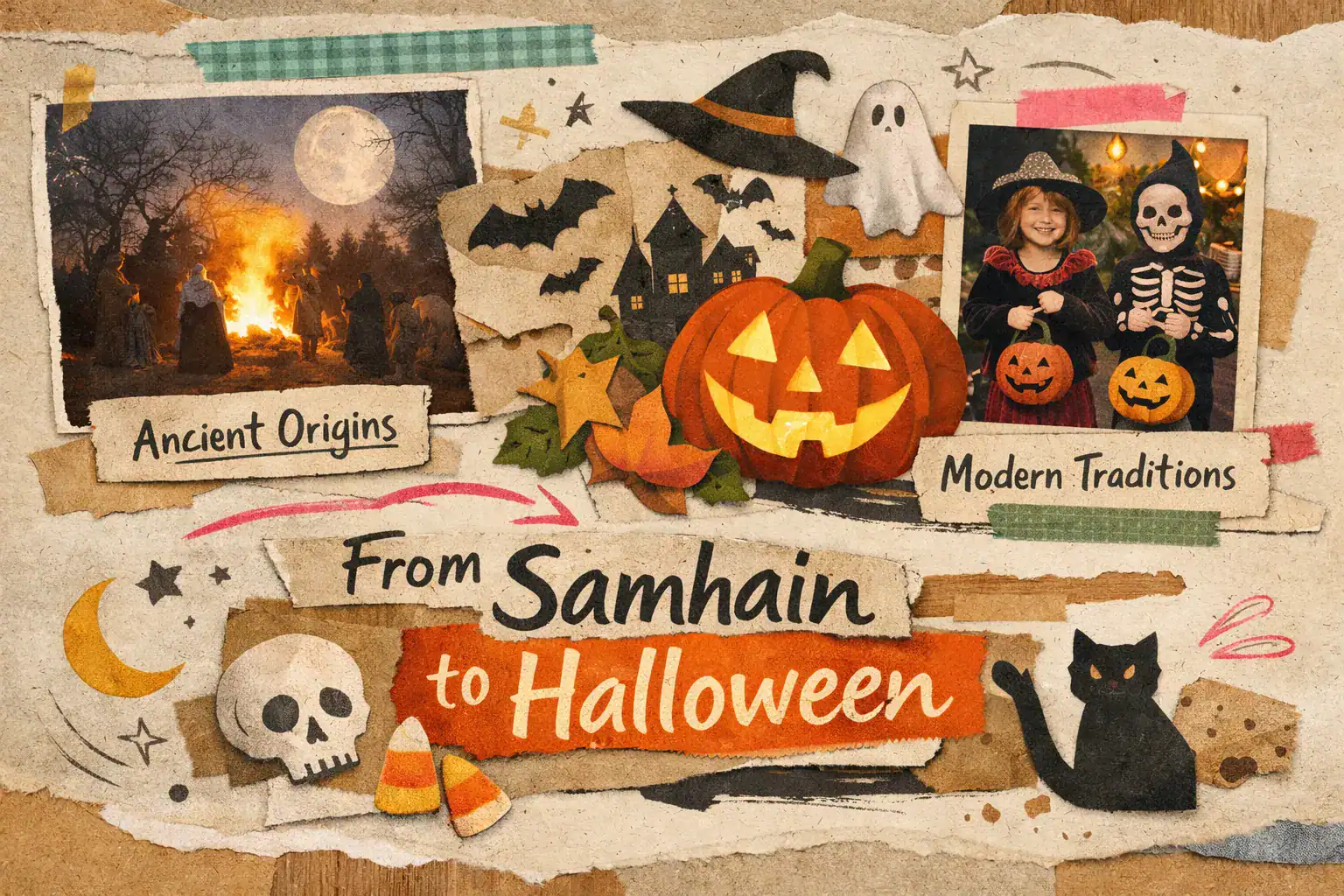
The origin of Halloween goes back to Samhain, the Gaelic year-turn, a time when harvest fields fell quiet and the boundary between the living and the Otherworld felt thin. Many familiar customs, such as costumes, carved lanterns and door-to-door treats, developed over centuries through interaction between pagan rites, medieval Christian observance and later popular reinvention. Below we trace why October 31 mattered, how bonfires, offerings and divination games shaped the festival, and how Irish and Scottish practices became trick-or-treat and the jack-o’-lantern in North America.
What you need to know
Over time, folk practices such as guising, bonfires and carved lights survived and adapted. Irish and Scottish migrants carried these customs to North America, where local materials and mass culture reshaped them into modern trick-or-treat, pumpkin carving and the seasonal spectacle we recognize today.
Origin of Halloween: Samhain and the ancient threshold
Samhain is the clearest starting point for the origin of Halloween. Marked from sunset on October 31 to sunset on November 1, it signaled the harvest’s end and the move into winter, a seasonal shift that made the night feel like a doorway between the living and the Otherworld. That liminal quality shapes many of Halloween’s symbols and anxieties.
Scholars reconstruct Samhain practices from medieval annals, later folklore and oral reports. Large communal bonfires feature consistently in those sources, with people and livestock passing beside or between flames for protection and purification, while offerings, feasts for the dead, divination games and quiet “dumb suppers” appear in ethnographies collected in the 19th and 20th centuries.
No single contemporary manual of Samhain survives, so historians weigh annals, archaeological traces and repeated folk customs to build plausible reconstructions. Where multiple independent sources align, claims gain confidence; where continuity rests on isolated later reports, interpretations remain inferential. With that caution, the next section shows how these liminal practices met Christian observance and were reframed within All Hallows’ rites.
All Hallows’ Eve and medieval overlays: church, dead and syncretism
Church calendars reshaped the season while leaving older customs in place. By the 8th and 9th centuries the church had set November 1 for a commemoration of martyrs, creating Allhallowtide: All Hallows’ Eve on October 31, All Saints on November 1 and All Souls on November 2. That overlay produced overlap with existing seasonal rites rather than replacing them outright.
Local practices such as souling and mumming fit into this liturgical frame. On All Souls Day, people went door to door asking for prayers in exchange for soul cakes, while mummers disguised themselves to perform for food or alms. Those behaviors contain clear threads that lead to later guising and trick-or-treat.
Parish registers, kirk session entries and municipal ordinances record “hollowmass,” fines for nocturnal fires and restrictions on masked processions, showing officials managing protection, piety and revelry. Reading those documents alongside folklore reveals continuity from bonfires and divination to disguised visitations and alms-seeking. From there, we can follow how early modern guising survived and how those customs traveled overseas.
From guising to jack-o’-lanterns: folk customs that survived
Many modern Halloween rituals began as neighborhood customs. Guising and souling saw children and adults go house to house with songs, prayers or short performances, receiving cakes, coins or charity in return; the exchange acted as entertainment and a small social safety net. Folklore collectors preserved dozens of rhymes and verses, such as “Soul-cakes, soul-cakes, three for a penny; One for Peter, two for Paul,” that sustained the calendar’s boundary work across generations.
The Stingy Jack story provides the narrative behind lantern carving. According to the tale, Jack tricks the devil and is barred from both heaven and hell, condemned to wander with a glowing ember inside a carved turnip. Communities hollowed root vegetables and placed embers within them as practical protective measures, and the jack-o’-lantern functioned as both a guide for wandering spirits and a warning to malevolent ones.
When Irish and Scottish migrants arrived in North America, pumpkins proved easier to hollow and carve than turnips, and their larger size made more visible lanterns. Nineteenth-century travel accounts and local newspapers note the pumpkin’s rapid adoption, an example of ritual adaptation to new resources. Together, guising, souling and lantern-carving show a chain of social exchange, boundary work and protective symbolism that feeds into the modern origin of Halloween.
Crossing the Atlantic: Irish and Scottish reinvention in North America
The Great Famine of the 1840s sent waves of Irish and Scottish migrants to North America, and with them came ritual memory. Immigrant communities recreated Samhain practices within fraternal societies, parishes and immigrant presses, adapting bonfires, divination games and guising to new neighborhoods and calendars. These transfers were adaptive rather than museum-style reproductions, since rituals survived where they met community needs. For more on that migration and cultural transfer, see discussions of how the Great Famine helped bring Halloween to America.
By the late 19th century, urban growth and moral reform movements changed how the night was staged. Puritan-descended New England frowned on revelry, while growing cities made unsanctioned mischief more visible; civic leaders, churches, schools and women’s clubs promoted child-centered parties, parades and safer amusements that gradually turned disorder into organized celebration.
Print culture and mass media sped up that transformation. The phrase “trick-or-treat” appears in Canadian newspapers in the 1920s, mid-century comics and advertisements normalized costumed children, and postwar candy packaging made handing out treats simple and hygienic. These cultural and commercial milestones turned local practice into a national habit and reshaped the origin story of Halloween in North America. For a concise overview of how trick-or-treating developed over time, see this history of the custom (the history of trick-or-treating).
Modern holiday mechanics: commercialization, media and cultural shifts
Individually wrapped candy, better packaging and suburban expansion turned pockets of guising into a predictable, large-scale ritual. Parents and community groups welcomed prepackaged sweets for safety and convenience, and retailers responded with seasonal displays and marketing that reinforced the habit. That feedback loop, with convenience driving participation and participation justifying marketing, helped convert neighborhood practice into national ritual.
Costumes shifted from concealment and protection to spectacle as department stores and catalogs advertised ready-made outfits. Mass production standardized characters and materials, so popular culture now often supplies the look of Halloween more than improvised straw and rags. The change altered how people imagine the night: creativity often means consumption, and familiar images move from film and television into porch scenes.
Alongside commercialization, late 20th-century revival movements reclaimed Samhain as a living practice. Modern pagan communities and some scholars emphasized seasonal rites, ancestor veneration and community ritual, creating a range of observance from heritage events to private devotional ceremonies. That tension between spectacle and revived ritual shapes how neighborhoods and institutions negotiate safety, tradition and public display today. For background on Samhain as a distinct festival and its continuing cultural role, consult the standard reference on Samhain.
Bringing Samhain home: authentic touches and responsible decor
To evoke Samhain at home, use simple, tactile cues that highlight night, harvest and remembrance. Candlelight and low, warm illumination suggest bonfire glow, while clusters of votives create a communal feel; natural fibers and muted palettes, such as wool throws, linen tablecloths and straw accents, keep textures grounded. Root vegetables and apples work as seasonal decor and edible props, and a modest remembrance table with a framed photo and a sprig of rosemary signals intention more clearly than elaborate altarwork.
Keep DIY implementations safe, simple and participatory. Offer a silent remembrance table where guests leave a note or token and then observe a brief five- to ten-minute quiet moment; that modern dumb supper honors ancestors without reenacting ritual rites. For lighthearted party activities, turn apple-peeling into a fortune game: peel a single ribbon, judge the shape or length for playful outcomes, then roast the slices to serve.
Choose vintage-inspired pieces that echo Samhain materials without claiming antiquity, such as aged brass votives, straw garlands, printed Stingy Jack cards or carved-gourd candleholders that feel handmade. Combine one statement item with natural elements to create atmosphere without slipping into costume-like appropriation. Above all, respect matters: cite your sources, avoid exoticizing living practices and treat ancestor commemoration with care.
Origin of Halloween: why the old ways still matter
The origin of Halloween is a layered story rather than a single unbroken lineage, rooted in Samhain and shaped by medieval church calendars and later popular reinvention. What survives today are fragments of social exchange, protection and remembrance, such as guising and souling, apotropaic lights and household symbols that adapted alongside commerce and media. These practices persisted because they answered real needs for memory, boundary and belonging, which is why carving a pumpkin or telling an old tale can still feel meaningful.
If you want to explore more about the origin of Halloween, Samhain rituals and other dark traditions, visit The Dark Threshold — Horror Blog | Paranormal, Legends & Supernatural for detailed histories, film and book reviews and hands-on Halloween guides. Try a simple, intentional observance this year: carve a modest jack-o’-lantern, leave a small remembrance and notice what the ritual stirs in you, then consider sharing your experience with our community.
Leave a Reply