
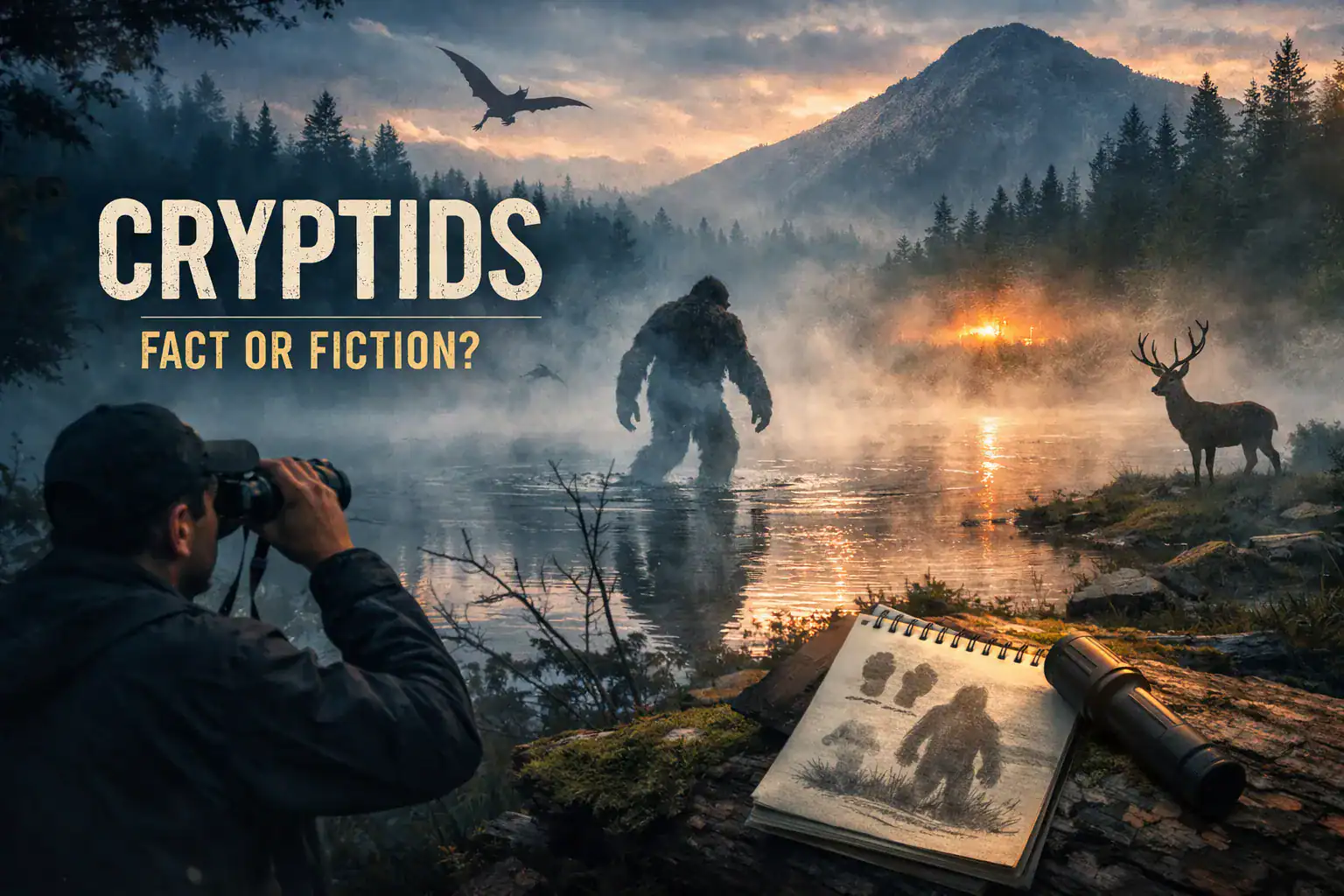
A blurry photograph drops online. A shaky clip surfaces on social media. Within hours, comment sections fracture into two familiar camps: believers who say this is finally the proof, and skeptics who call it a dog in bad lighting. This cycle has been running long before the internet existed, and the central question it raises, whether cryptids are real organisms science hasn’t confirmed or simply misidentified animals we know well, has a more rigorous answer than either camp typically acknowledges.
So: are cryptids real or just misidentified animals? The honest answer is that most documented sightings fall into the misidentified or fabricated column, but a meaningful minority remain unresolved, and history has occasionally vindicated the believers. At The Dark Threshold, we’ve built an archive of individual cryptid investigations, case by case, creature by creature. This article is the analytical backbone behind all of them. The goal isn’t to debunk or to evangelize. It’s to hand you a working framework for evaluating any alleged sighting using the same tools researchers and skeptics actually deploy. What follows covers the biological and cognitive causes of misidentification, nine major cases examined against the evidence, species history once dismissed as myth, the scientific methods investigators use, and a practical checklist you can apply yourself.
Are Cryptids Real or Just Misidentified Animals? Why So Many Sightings Fall Apart Under Scrutiny
Misidentification is not a character flaw. The human brain makes its best guess under pressure, and in unfamiliar terrain, at night, or across a body of water, that guess is often wrong. Understanding why helps you read sighting reports far more critically.
The biological culprits behind legendary creatures
Bears walking upright account for a significant share of Bigfoot-adjacent reports. Mangy coyotes and dogs with advanced mange look genuinely unrecognizable, and this is precisely where many Chupacabra encounters originate. Decomposing marine carcasses, called globsters, have triggered sea serpent reports for centuries, as gases bloat and distort familiar animal forms into something monstrous. Seals, large fish, and wading birds explain the majority of lake monster sightings when viewed from distance or at an unusual angle. These aren’t speculative guesses: in many documented cases, DNA testing and direct physical comparison have confirmed the substitution.
What environment and perception do to a witness’s brain
Poor lighting, fog, foliage, and moving water all compress depth and alter apparent size. Pareidolia, the brain’s pattern-recognition system constructing familiar shapes from ambiguous stimuli, fires before conscious analysis can intervene. Per visual neuroscience studies on face detection, these responses activate within approximately 165 milliseconds, faster than deliberate thought. Fatigue and stress compound the problem, and memory consolidation over hours and days reshapes what a witness believes they saw, encoding the narrative they settled on rather than the raw visual event. This isn’t about dishonesty; it’s about how unreliable human perception genuinely is under specific conditions.
Hoaxes and fabrication: more common than believers want to admit
The 1934 Loch Ness “surgeon’s photograph” was revealed in 1994 to be a plastic and wooden head mounted on a toy submarine, orchestrated by Marmaduke Wetherell, the same man who planted fake hippo-foot tracks near the loch the year before. Footprint hoaxes and fabricated casts have been demonstrated in multiple documented Bigfoot cases, including confessions by hoaxers who used carved wooden feet and plaster molds. The hoax rate matters because it inflates the total sighting count, making genuine anomalies harder to isolate from the noise.
Nine High-Profile Cryptid Cases: Real or Misidentified?
Not every case resolves cleanly, and intellectual honesty requires acknowledging that. What follows shows what the evidence for and the evidence against looks like across the major cases.
Lake monsters: Nessie, Champ, and the eel hypothesis
A 2018 environmental DNA survey of Loch Ness, conducted by Neil Gemmell and colleagues at the University of Otago, found substantial eel DNA throughout the water column, leading researchers to propose a large, unusual eel as the most scientifically supportable explanation for sighting reports. Italian geologist Luigi Piccardi has separately linked many sighting accounts to geological activity from the Great Glen fault system, which produces surface bubbles and tremors that could be misread as a large animal moving. Champ, the reported creature of Lake Champlain, draws similar explanations: seals, large fish, driftwood, and wave interference patterns account for most documented accounts.
Ape-like creatures: Bigfoot and the Yeti’s DNA problem
Oxford geneticist Bryan Sykes and colleagues analyzed 37 hair samples claimed to be from anomalous primates (Sykes et al., 2014). Of the 30 that yielded usable DNA, every single one matched a known species: bears, horses, wolves, dogs, humans, cows, raccoons, deer, and a porcupine. Two Himalayan samples showed affinity with a Paleolithic polar bear rather than an unknown primate. Footprint forensic analysis using dermal ridge examination has also failed to produce consistent, verifiable evidence of an unknown great ape. The ecological implausibility argument compounds this: a breeding population large enough to sustain itself would leave far more physical evidence, including remains, than has ever been recovered.
Humanoid and blood-draining cryptids: Mothman and the Chupacabra
Mothman sightings concentrated around Point Pleasant, West Virginia between 1966 and 1967. Wildlife biologist Dr. Robert L. Smith identified the sandhill crane as the most likely explanation: nearly as tall as a human, with a six-to-seven-foot wingspan and bright red skin around the eyes that produces striking eyeshine in low light. Media coverage and community rumor then standardized and amplified descriptions over time, a process social psychologists call conformity bias. The Chupacabra follows an even cleaner trajectory: early Puerto Rican reports from the 1990s described a spiny, alien-like creature, while subsequent US sightings consistently describe a hairless, canine animal. DNA analysis of every carcass labeled Chupacabra has confirmed known canids with advanced mange.
The remaining cases in this survey share similar patterns, though the evidence varies in quality. Mokele-Mbembe sightings in the Congo Basin are frequently attributed by skeptical researchers to misidentified hippos or large monitor lizards, though no definitive resolution has been published. The Dover Demon, reported in Massachusetts in 1977, has been tentatively compared to a young moose or foal seen in poor light, though this remains a speculative hypothesis rather than a confirmed identification. The Beast of Gevaudan, which killed dozens in 18th-century France, is now broadly attributed to a large wolf or wolf-dog hybrid, supported by contemporary records and physical descriptions of the animal eventually killed. The Orang Pendek of Sumatra remains the most genuinely unresolved of the group, with multiple field researchers, including those from the Centre for Fortean Zoology, considering it a plausible candidate for an unconfirmed primate species in dense, under-surveyed forest.
Cryptids that science eventually confirmed exist
This section carries weight, and it should. Acknowledging confirmed cases is essential to any balanced analysis, and it explains why serious cryptozoologists argue that dismissal without investigation is as unscientific as uncritical belief.
From folklore to field specimen: okapi, gorilla, giant squid, Komodo dragon
Central African tribes described the okapi for generations before Western science collected skins and skeletons in 1901 and formally recognized it as a relative of the giraffe. The mountain gorilla was documented through skulls and skins as early as 1847, but remained effectively unknown to the wider scientific world until Robert von Beringe collected specimens in the Virunga highlands in 1902, confirming a distinct subspecies in remote terrain. The giant squid appears in ancient accounts going back to Aristotle and was confirmed through beached carcasses, sperm whale stomach contents, and finally live photography in 2004. The Komodo dragon was reported by Indonesians but dismissed until a live specimen reached a museum in 1910. The platypus arrived in England in 1799 and was initially suspected to be a taxidermy hoax by British scientists before its biology was accepted.
What these confirmations actually mean for responsible investigation
These aren’t edge cases. They represent a clear pattern: remote or hard-to-access habitats genuinely harbor animals unknown to Western science. Deep ocean, dense equatorial forest, and island ecosystems have all produced confirmed surprises within the last two centuries. The lesson is methodological: the standard of evidence needs to be proportional to the claim’s scope, but the investigation itself should always be conducted rigorously and without predetermined conclusions. This is the legitimate core of cryptozoology, stripped of sensationalism.
The scientific toolkit investigators actually use
Environmental DNA, trace evidence, and hair analysis
The 2018 Loch Ness eDNA survey (Gemmell et al.) is the clearest example of the methodology in practice. Water samples collected from depths ranging from half a meter to 200 meters were processed against genetic databases, detecting every known species in the loch. Any organism present in a body of water sheds genetic material through skin cells, waste, and mucus, making eDNA one of the most sensitive non-invasive detection tools available. Hair and scat samples are processed against reference databases of known species, and any unmatched result would theoretically flag a new organism. In practice, samples that returned unmatched results were invariably degraded or contaminated, not evidence of an unknown species.
Photographic forensics, camera traps, and ecological plausibility checks
Photographic forensics examines lighting consistency, perspective distortion, zoom artifacts, and motion blur to determine whether an image is consistent with its claimed context. Trail cameras and thermal imaging now cover wilderness areas with far greater density than in past decades, yet no confirmed cryptid evidence has emerged from them. Ecological plausibility studies model whether a habitat could sustain a breeding population, examining food availability, territory size, and the statistical likelihood of physical trace evidence appearing over time. Investigators also cross-reference sighting clusters against historical indigenous accounts and documented environmental changes in the area, building a fuller picture than any single witness report can provide.
Why the belief persists even when the evidence doesn’t
Pareidolia, memory distortion, and the limits of eyewitness testimony
Pareidolia drives initial perception: the brain constructs a coherent shape from ambiguous input before conscious analysis can engage. Memory consolidation then encodes whatever narrative the person settled on, not necessarily what they originally perceived. Elizabeth Loftus’s eyewitness research consistently shows that confidence in a memory does not correlate with its accuracy, and that repeated retelling reinforces errors rather than correcting them. Most cryptid sightings are brief, unexpected, and occur in low-visibility conditions, precisely the scenario where these cognitive failures are most pronounced.
How media cycles and community dynamics amplify uncertain sightings
When a sighting receives coverage, subsequent witnesses unconsciously match their descriptions to what’s already been reported. This conformity bias explains why Mothman reports standardized over the months of the Point Pleasant sightings: the community shared a description, and new observers filtered their experiences through it. Social media accelerates this process enormously, with a grainy clip generating thousands of comment-thread interpretations that then shape how new witnesses frame their own experiences. This isn’t conspiracy; it’s how human social cognition works, and it’s why cryptid sightings cluster so reliably in both location and description.
How to evaluate a new cryptid report like a field researcher
The core questions every credible investigation starts with
Before drawing any conclusion from a sighting report, run through this baseline framework: What were the lighting conditions and how long did the sighting last? Were there multiple independent witnesses who gave accounts before comparing notes? Has the area been examined for physical trace evidence, including tracks, scat, hair, and disturbed vegetation? Is the reported size, behavior, and habitat consistent with what a breeding population would ecologically require? Does the account predate or postdate major media coverage of that cryptid type? These questions don’t exist to dismiss. They exist because any credible investigation requires them before anything else.
Red flags that signal hoax or misidentification, and where to go deeper
The clearest warning signs: a single grainy image with no corroborating physical evidence, accounts that grow more detailed and dramatic across multiple tellings, reports that closely mirror a recently viral media story, and physical evidence that disappears before independent analysis. Research on eyewitness memory distortion and conformity bias supports each of these as reliable indicators of unreliable testimony. The hallmarks of a genuine anomaly worth further investigation look different: multiple independent witnesses with consistent accounts given before they compared notes, physical trace evidence collected and preserved correctly, and sightings in ecologically plausible terrain with no obvious known-animal match. When those conditions exist, the case earns a serious look.
The Dark Threshold’s cryptid investigation archive applies exactly this framework to individual creatures, from Mothman to Skinwalkers, with the same evidence-first approach used here. Each case file examines the evidence on both sides without predetermining the conclusion. If a specific creature brought you to this article, the archive is your next stop.
The honest answer: are cryptids real or just misidentified animals?
Most documented cryptid sightings have biological, environmental, or fabricated explanations that hold up under rigorous examination. A smaller number remain genuinely unresolved, and history shows that “unknown” occasionally becomes “confirmed specimen in a museum.” The most intellectually honest position isn’t belief or dismissal; it’s the same methodology science applies to anything else: rigorous evidence standards, willingness to revise conclusions, and respect for the complexity of what we still don’t know about the natural world.
You now have the vocabulary and the framework to evaluate new claims independently. The next time a blurry photograph drops and the internet splits into its familiar camps, you know the questions to ask before joining either side. Apply that framework to The Dark Threshold’s ongoing cryptid investigations, where each case receives exactly the level of scrutiny this article has outlined. The archive is waiting, and the evidence is more interesting than either camp typically acknowledges.
Leave a Reply