Picture this: you’re scrolling YouTube at 2 a.m. when you find a video that looks like a corrupted television broadcast from 1994. The image warps. The audio cuts out mid-sentence. An announcer reads instructions that make no sense, and something in the background moves when it shouldn’t. You don’t know what you just watched, and you can’t stop thinking about it. That’s analog horror explained in a single viewing experience, the genre working exactly as designed.
This subgenre has become one of the most quietly disturbing developments in internet culture over the past two decades. It doesn’t scare you with jump cuts or gore. It scares you with the look and feel of broken, obsolete media, turning the static of a dead channel into something that feels deeply, wrongly alive. At The Dark Threshold, we live for exactly this kind of horror: the kind that gets under your skin before you can name why.
By the time you finish reading, you’ll be able to define the genre, trace its roots back to the weird corners of early YouTube, recognize its signature tropes, and know exactly which series to watch first. This is your complete field guide to one of horror’s most atmospheric and accessible subgenres.
Analog horror explained: what the genre actually is
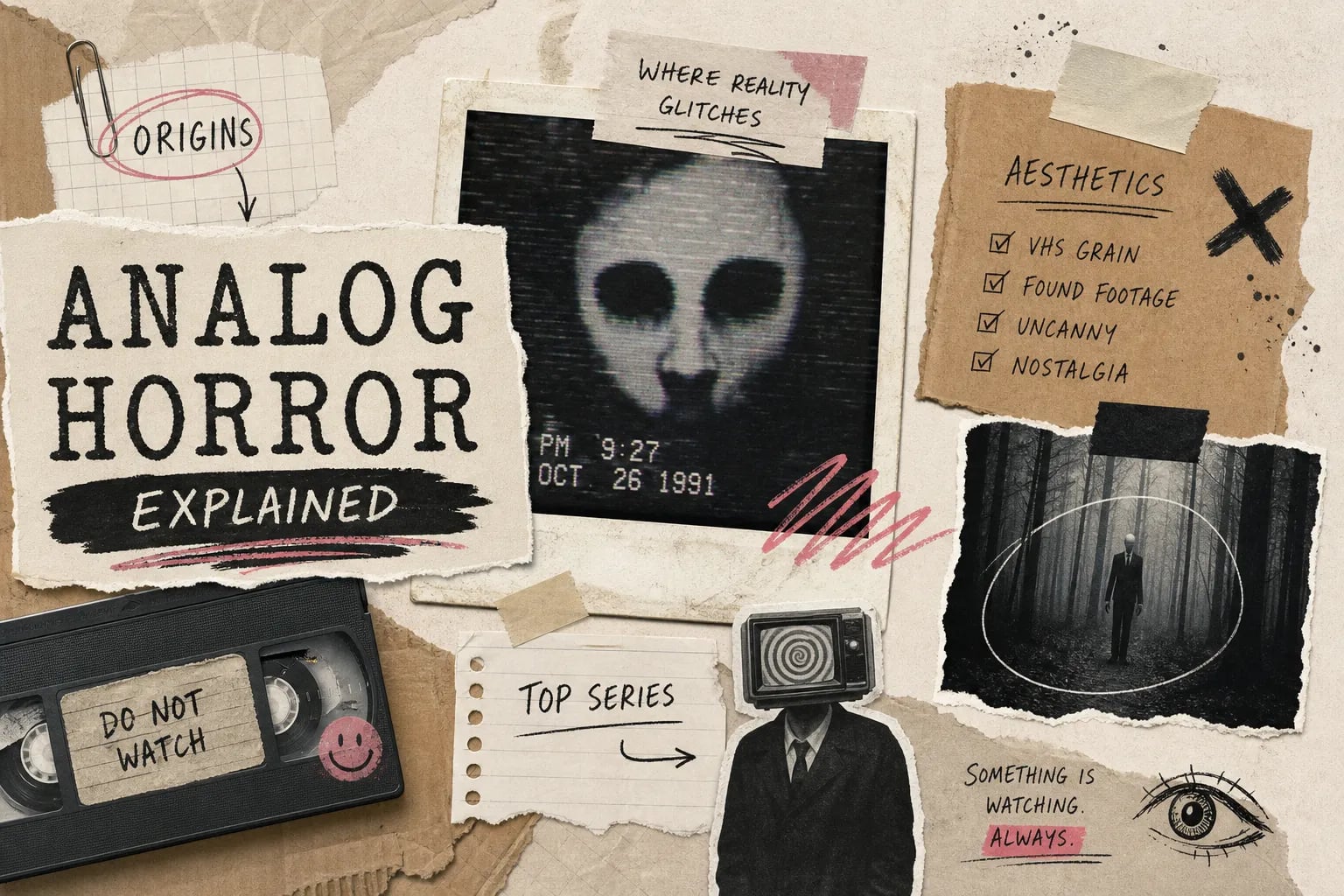
At its core, analog horror is a subgenre that uses the degraded look and sound of obsolete analog media to create dread. The instruments are specific: VHS tapes, CRT television sets, cassette audio, emergency broadcast alerts, and public-access channels. The format itself does the frightening, not a conventional monster or jump scare. You’re not watching a creature attack someone; you’re watching a signal that feels fundamentally wrong.
That distinction carries more weight than it might seem. Most horror genres put scary things on screen. Analog horror puts the corruption of the screen itself at the center of the experience. When the image warps, when audio drops out mid-word, when an official-looking transmission suddenly says something it shouldn’t, that is the horror event. The genre leans entirely on suggestion, environmental storytelling, and implied threats rather than explicit violence or visible monsters. This is why newcomers often feel deeply unsettled without being able to identify what, specifically, scared them.
The haunted media feeling is the whole point. You’re not watching a story unfold so much as receiving something old, broken, and unauthorized. That psychological gap, the space between the familiar comfort of old broadcast aesthetics and the wrongness bleeding through them, is where the genre lives, and analog horror explained properly is really just a description of that gap.
Where the genre came from: YouTube, VHS nostalgia, and internet horror
Analog horror didn’t arrive fully formed. It grew out of the late 2000s internet horror scene, assembling itself from creepypasta culture, early YouTube experimentation, and a deep fascination with obsolete media. 2009 proved to be a particularly fertile moment: the internet was developing a hunger for participatory, immersive horror that traditional film couldn’t satisfy, and several creators independently found the same raw material at the same time. Marble Hornets (2009) established conventions for internet-based found-footage horror and planted seeds the genre would later cultivate. Emergency Alert System simulation videos, circulating as early as 2007, contributed the “broadcast interruption” aesthetic that would become one of analog horror’s most recognizable signatures.
Kris Straub’s creepypasta Candle Cove (2009) also played a foundational role, using the eerie texture of nostalgic television memory as a horror device long before the video format existed. Steven Chamberlain’s No Through Road (2009) is frequently cited as one of the earliest video works in the genre’s lineage.
The moment the subgenre became recognizable and widely named came in October 2015, when Straub uploaded the first episode of Local 58 to YouTube. That series did more than produce compelling horror content; it actually named the subgenre through its channel branding: “ANALOG HORROR AT 476 MHz.” YouTube was the natural home for this kind of work because the platform offered free distribution to a global audience already primed by creepypasta culture, and its short-form structure was perfect for fragmented, episodic content that rewards repeat viewing. (Some sources cite 2017 due to a channel relaunch and reupload, but the original first upload is documented as October 2015.)
Analog horror vs. found footage: understanding the real difference
These two terms get used interchangeably online, and they shouldn’t. Found footage is a broad storytelling device: events presented as discovered recordings. That definition covers everything from The Blair Witch Project to smartphone horror shorts posted to TikTok. The recording quality doesn’t matter. What matters is that a character held a camera and filmed something, and we’re watching their footage.
Analog horror is narrower. It specifically imitates pre-digital visual language and frames the horror through institutional media, archived broadcasts, training tapes, public-access channels, or emergency transmissions. On-screen characters are rare or absent entirely. There’s no one holding a camera. The horror isn’t “look what this person filmed”; it’s “something is wrong with the signal itself.” The viewer isn’t watching someone’s experience; they’re receiving a corrupted transmission.
The cleanest way to hold the two apart: found footage says “this story is told through discovered recordings.” Analog horror says “this ordinary media has itself become haunted or corrupted.” One centers human perspective; the other removes it almost entirely, leaving you alone with the static.
The signature tropes and aesthetics that define the VHS horror aesthetic
The visual grammar of analog horror is specific and intentional. VHS tracking lines, tape warping, ghosting, chroma bleed, CRT scanlines, phosphor glow, and timestamp overlays aren’t decorative choices, they’re signals to the viewer that the transmission has been compromised. When you see those artifacts, your brain registers “this footage has been damaged” before you consciously process what’s wrong with the content itself. The aesthetic primes the dread before anything actually happens.
Visual tropes
Beyond the surface-level grain and warping, the visual grammar of analog horror relies heavily on what it withholds. Partially redacted text, figures glimpsed in background frames, timestamps that shouldn’t be possible, and footage that begins completely mundanely before becoming inexplicably wrong, these are the genre’s standard visual moves. A shape glimpsed in the corner of a corrupted frame lands harder than any visible monster, because your imagination is doing most of the work.
Audio tropes
The audio follows the same logic as the visuals but hits differently. Tape hiss, signal dropouts, audio warble, uncanny broadcast tones, and the deliberate absence of a music score all work together to make the footage feel like genuine archival media. A traditional horror score tells you when to be afraid. Analog horror refuses that reassurance, stranding you in footage that already feels broken and offering no musical cues to guide your response.
Many analog horror projects also extend into ARG (alternate reality game) territory, hiding messages across platforms and turning audiences into active investigators. That participatory element deepens the sense that you’ve stumbled into something real and unauthorized, a core part of what makes analog horror tropes so effective compared to passive viewing experiences.
The must-watch series every newcomer should start with
Four series define what the genre is capable of, and every newcomer should work through them roughly in this order.
- Local 58 (Kris Straub, 2015): The genre-defining work that gave analog horror its name. Fake broadcast transmissions from a regional TV station that begins airing deeply, increasingly wrong content. Start here. It’s short, atmospheric, and immediately communicates what this genre feels like.
- Gemini Home Entertainment (Remy Abode, 2019): A VHS home-video series where the familiar warmth of nature documentaries curdles into something alien. The pacing is patient and suffocating in equal measure.
- The Walten Files (Martin Walls, 2020): Lo-fi horror built around an animatronic-themed narrative that feels like a corrupted Chuck E. Cheese training tape from a company with a catastrophically dark history. The series draws strong audience responses for both its unsettling atmosphere and unexpected emotional depth.
- The Mandela Catalogue (Alex Kister, 2021): A faux emergency-broadcast series about an entity that mimics people, layered with religious and paranormal unease. As of 2026, the series has surpassed 100 million views and has been acquired for a feature-film adaptation by Amazon MGM Studios and Amblin, with Kister set to direct, details reported by trades including Deadline.
All four are free on YouTube, consistent with how the genre has always distributed itself: this is a YouTube-native form by origin and by design. For historical context, No Through Road (2009) and Marble Hornets (2009) are worth your time after you’ve grounded yourself in the core four. And if liminal space horror pulls you in, The Backrooms by Kane Parsons (2022) bridges both genres effectively. That project reached theaters on May 29, 2026, with a planned move to HBO Max streaming later in the year, a trajectory that says a great deal about where the genre is heading.
How creators build the analog horror look, and where to keep exploring
The production side of analog horror is more accessible than you’d expect. Most of what you see in these videos is built with standard editing software: Adobe After Effects, Premiere Pro, or DaVinci Resolve for video, and Audacity or Adobe Audition for audio. The actual VHS horror aesthetic comes from layering grain, tracking glitches, chroma bleed, and audio hiss over clean source footage using dedicated VHS plugins, noise generators, and tape saturation tools. The goal is to build up damage in layers so the result feels like genuine analog deterioration rather than a single obvious filter.
For beginners in 2026, a solid starting stack looks like this: DaVinci Resolve or CapCut for editing, Audacity for audio degradation, GIMP or Photopea for graphics, and free VHS overlay packs or tools like NTSC RS for the lo-fi visual look. Most creators working in the genre recommend starting simple and focusing on atmosphere first. The mystery and the suggestion carry more weight than technical perfection. Some of the genre’s most unsettling moments were made with free software and a strong concept.
That accessibility is a core reason the genre keeps growing. A creator with a laptop and a willingness to sit in the discomfort of unresolved dread can produce something that genuinely gets under people’s skin. The barrier to entry is low; the ceiling on what’s possible keeps rising.
If you want to go deeper, The Dark Threshold covers the genre’s expanding catalogue with the attention it deserves: creator spotlights, trope deep-dives, recommendations for series you haven’t found yet, and coverage of the newest corrupted signals appearing on YouTube. This community is built for people who find something in the static, and there’s always more worth watching.
Analog horror explained: why the broken signal endures
Analog horror works because it turns the familiar into something wrong. The look of a 1990s children’s broadcast, the sound of an emergency alert, the warmth of a home video, the genre takes these safe, comfortable textures and lets something terrible seep through them. It was born in the weird corners of early YouTube, named by Local 58 in 2015, and has grown into one of the most vital subgenres in horror today. The Mandela Catalogue is heading to theaters. The Backrooms already got there. The genre that started as fragmented uploads on a video platform is now drawing tens of millions of viewers across its defining series, and it hasn’t lost an ounce of its unsettling intimacy. That’s analog horror explained, the signal is broken on purpose, and that’s exactly the point. Come find us at The Dark Threshold when you’re ready to go further into the static.
Leave a Reply